


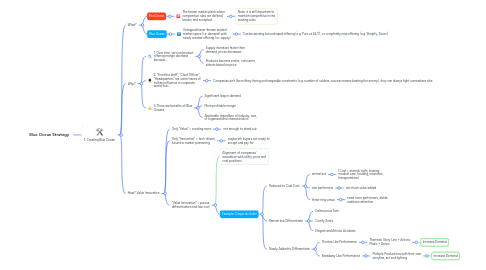
1. 1. Creating Blue Ocean
1.1. What?
1.1.1. Red Ocean
1.1.1.1. The known market place where competitive rules are defined, known, and accepted.
1.1.1.1.1. Note: it is still important to maintain competitive in the existing rules
1.1.2. Blue Ocean
1.1.2.1. Untapped/never-known existed market space (i.e. demand) with newly created offering (i.e. supply)
1.1.2.1.1. Can be existing but reshaped offering (e.g. Pure vs 24/7), or completely new offering (e.g. Shopify, Zoom)
1.2. Why?
1.2.1. 1. Over time, service/product offering margin decrease because...
1.2.1.1. Supply increases faster than demand, prices decreases
1.2.1.2. Products become similar, consumer selects based on price
1.2.2. 2. "Frontline staff", "Chief Officer", "Headquarters" are some traces of military influence in corporate world, but...
1.2.2.1. Companies ain't like military facing unchangeable constraints (e.g. number of solders, success means beating the enemy), they can always fight somewhere else
1.2.3. 3. There are benefits of Blue Oceans
1.2.3.1. Significant leap in demand
1.2.3.2. More profitable margin
1.2.3.3. Applicable regardless of industry, size, or organizational characteristics
1.3. How? Value Innovation
1.3.1. Only "Value" = creating more
1.3.1.1. not enough to stand out
1.3.2. Only "Innovation" = tech-driven, futuristic market pioneering
1.3.2.1. maybe sth buyers not ready to accept and pay for
1.3.3. "Value Innovation" = pursue differentiation and low cost
1.3.3.1. Alignment of companies' innovation with utility, price and cost positions
1.3.3.2. Example: Cirque du Soleil
1.3.3.2.1. Reduced to Cust Cost
1.3.3.2.2. Remain but Differentiate
1.3.3.2.3. Newly Added to Differentiate