Unlock the full potential of your projects.
Try MeisterTask for free.
Vous n'avez pas de compte ?
Inscription gratuite
Parcourir
Cartes en vedette
Catégories
Gestion de projet
Objectifs d'affaires
Ressources humaines
Brainstorming et analyse
Marketing et contenu
Éducation et remarques
Loisirs
Vie courante
Technologie
Design
Résumés
Autre
Langues
English
Deutsch
Français
Español
Português
Nederlands
Dansk
Русский
日本語
Italiano
简体中文
한국어
Autre
Montrer carte totale
Copier éditer carte
Copier
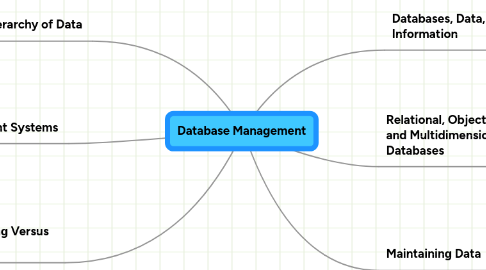
Database Management
Autre
BE
B Eeriolovegod
Suivre
Lancez-Vous.
C'est gratuit
S'inscrire avec Google
ou
s'inscrire
avec votre adresse e-mail
Cartes mentales similaires
Plan de carte mentale
Database Management
par
B Eeriolovegod
1. The Hierarchy of Data
1.1. Data is organized in layers
1.2. Common data types include
1.3. A record is a group of related fields
2. File Processing Versus Databases
3. Database Management Systems
3.1. A data dictionary contains data about each file in the database and each field in those files
3.2. A DBMS provides several tools that allow users and programs to retrieve and maintain data in the database
4. Databases, Data, and Information
4.1. Database software, often called a database management system (DBMS), allows users
4.2. Garbage in, garbage out (GIGO) points out the accuracy of a computer’s output depends on the accuracy of the input
4.3. Valuable information should have the following characteristics
5. Maintaining Data
5.1. File maintenance refers to the procedures that keep data current
5.2. Users add new records to a file when they obtain new data
5.3. Users modify a record to correct inaccurate data or update old data
6. Relational, Object‐Oriented, and Multidimensional Databases
6.1. A data model consists of rules and standards that define how the database organizes data
6.2. A relational database stores data in tables that consist of rows and columns – Each row has a primary key – Each column has a unique name
Lancez-vous. C'est gratuit!
Connectez-vous avec Google
ou
S'inscrire