


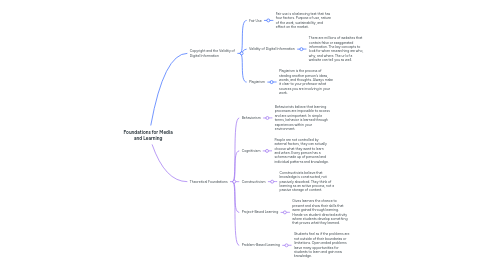
1. Copyright and the Validity of Digital Information
1.1. Fair Use
1.1.1. Fair use is a balancing test that has four factors. Purpose of use, nature of the work, sustainability, and effect on the market.
1.2. Validity of Digital Information
1.2.1. There are millions of websites that contain false or exaggerated information. The key concepts to look for when researching are who, why, and where. The url of a website can tell you as well.
1.3. Plagiarism
1.3.1. Plagiarism is the process of stealing another person's ideas, words, and thoughts. Always make it clear to your professor what sources you are involving in your work.
2. Theoretical Foundations
2.1. Behaviorism
2.1.1. Behaviorists believe that learning processes are impossible to access and are unimportant. In simple terms, behavior is learned through experiences within your environment.
2.2. Cognitivism
2.2.1. People are not controlled by external factors, they can actually choose what they want to learn and when. Every person has a schema made up of personal and individual patterns and knowledge.
2.3. Constructivism
2.3.1. Constructivists believe that knowledge is constructed, not passively absorbed. They think of learning as an active process, not a passive storage of content.
2.4. Project-Based Learning
2.4.1. Gives learners the chance to present and show their skills that were gained through learning. Hands-on student directed activity where students develop something that proves what they learned.
2.5. Problem-Based Learning
2.5.1. Students feel as if the problems are not outside of their boundaries or limitations. Open ended problems leave many opportunities for students to learn and gain new knowledge.