Principles for Financial Market Infrastructurespar Nélio Magina Jr.
1. DEFAULT MANAGEMENT
1.1. 13: Participant-default rules and procedures An FMI should have effective and clearly defined rules and procedures to manage a participant default. These rules and procedures should be designed to ensure that the FMI can take timely action to contain losses and liquidity pressures and continue to meet its obligations.
1.2. 14: Segregation and portability A CCP should have rules and procedures that enable the segregation and portability of positions of a participant’s customers and the collateral provided to the CCP with respect to those positions.
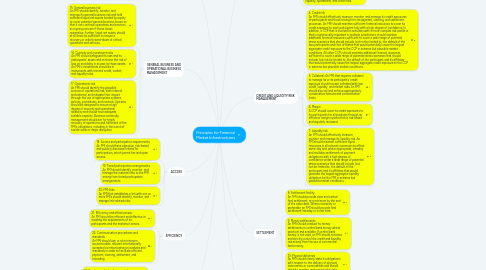
2. GENERAL BUSINESS AND OPERATIONAL BUSINESS MANAGEMENT
2.1. 15: General business risk An FMI should identify, monitor, and manage its general business risk and hold sufficient liquid net assets funded by equity to cover potential general business losses so that it can continue operations and services as a going concern if those losses materialise. Further, liquid net assets should at all times be sufficient to ensure a recovery or orderly wind-down of critical operations and services.
2.2. 16: Custody and investment risks An FMI should safeguard its own and its participants’ assets and minimise the risk of loss on and delay in access to these assets. An FMI’s investments should be in instruments with minimal credit, market, and liquidity risks.
2.3. 17: Operational risk An FMI should identify the plausible sources of operational risk, both internal and external, and mitigate their impact through the use of appropriate systems, policies, procedures, and controls. Systems should be designed to ensure a high degree of security and operational reliability and should have adequate, scalable capacity. Business continuity management should aim for timely recovery of operations and fulfilment of the FMI’s obligations, including in the event of a wide-scale or major disruption.
3. ACCESS
3.1. 18: Access and participation requirements An FMI should have objective, risk-based, and publicly disclosed criteria for participation, which permit fair and open access.
3.2. 19: Tiered participation arrangements An FMI should identify, monitor, and manage the material risks to the FMI arising from tiered participation arrangements.
3.3. 20: FMI links An FMI that establishes a link with one or more FMIs should identify, monitor, and manage link-related risks.
4. EFFICIENCY
4.1. 21: Efficiency and effectiveness An FMI should be efficient and effective in meeting the requirements of its participants and the markets it serves.
4.2. 22: Communication procedures and standards An FMI should use, or at a minimum accommodate, relevant internationally accepted communication procedures and standards in order to facilitate efficient payment, clearing, settlement, and recording.
5. TRANSPARENCY
5.1. 23: Disclosure of rules, key procedures, and market data An FMI should have clear and comprehensive rules and procedures and should provide sufficient information to enable participants to have an accurate understanding of the risks, fees, and other material costs they incur by participating in the FMI. All relevant rules and key procedures should be publicly disclosed.
5.2. 24: Disclosure of market data by trade repositories A TR should provide timely and accurate data to relevant authorities and the public in line with their respective needs.
6. GENERAL ORGANISATION
6.1. 1: Legal basis An FMI should have a well-founded, clear, transparent, and enforceable legal basis for each material aspect of its activities in all relevant jurisdictions.
6.2. 2: Governance An FMI should have governance arrangements that are clear and transparent, promote the safety and efficiency of the FMI, and support the stability of the broader financial system, other relevant public interest considerations, and the objectives of relevant stakeholders.
6.3. 3: Framework for the comprehensive management of risks An FMI should have a sound risk-management framework for comprehensively managing legal, credit, liquidity, operational, and other risks.
7. CREDIT AND LIQUIDITY RISK MANAGEMENT
7.1. 4: Credit risk An FMI should effectively measure, monitor, and manage its credit exposures to participants and those arising from its payment, clearing, and settlement processes. An FMI should maintain sufficient financial resources to cover its credit exposure to each participant fully with a high degree of confidence. In addition, a CCP that is involved in activities with a more-complex risk profile or that is systemically important in multiple jurisdictions should maintain additional financial resources sufficient to cover a wide range of potential stress scenarios that should include, but not be limited to, the default of the two participants and their affiliates that would potentially cause the largest aggregate credit exposure to the CCP in extreme but plausible market conditions. All other CCPs should maintain additional financial resources sufficient to cover a wide range of potential stress scenarios that should include, but not be limited to, the default of the participant and its affiliates that would potentially cause the largest aggregate credit exposure to the CCP in extreme but plausible market conditions.
7.2. 5: Collateral: An FMI that requires collateral to manage its or its participants’ credit exposure should accept collateral with low credit, liquidity, and market risks. An FMI should also set and enforce appropriately conservative haircuts and concentration limits.
7.3. 6: Margin A CCP should cover its credit exposures to its participants for all products through an effective margin system that is risk-based and regularly reviewed.
7.4. 7: Liquidity risk An FMI should effectively measure, monitor, and manage its liquidity risk. An FMI should maintain sufficient liquid resources in all relevant currencies to effect same-day and, where appropriate, intraday and multiday settlement of payment obligations with a high degree of confidence under a wide range of potential stress scenarios that should include, but not be limited to, the default of the participant and its affiliates that would generate the largest aggregate liquidity obligation for the FMI in extreme but plausible market conditions.
8. SETTLEMENT
8.1. 8: Settlement finality An FMI should provide clear and certain final settlement, at a minimum by the end of the value date. Where necessary or preferable, an FMI should provide final settlement intraday or in real time.
8.2. 9: Money settlements An FMI should conduct its money settlements in central bank money where practical and available. If central bank money is not used, an FMI should minimise and strictly control the credit and liquidity risk arising from the use of commercial bank money.
8.3. 10: Physical deliveries An FMI should clearly state its obligations with respect to the delivery of physical instruments or commodities and should identify, monitor, and manage the risks associated with such physical deliveries.
9. CENTRAL SECURITIES DEPOSITORIES AND EXCHANGE-OF-VAUE SETTLEMENT SYSTEMS
9.1. 11: Central securities depositories A CSD should have appropriate rules and procedures to help ensure the integrity of securities issues and minimise and manage the risks associated with the safekeeping and transfer of securities. A CSD should maintain securities in an immobilised or dematerialised form for their transfer by book entry.
9.2. 12: Exchange-of-value settlement systems If an FMI settles transactions that involve the settlement of two linked obligations (for example, securities or foreign exchange transactions), it should eliminate principal risk by conditioning the final settlement of one obligation upon the final settlement of the other.