
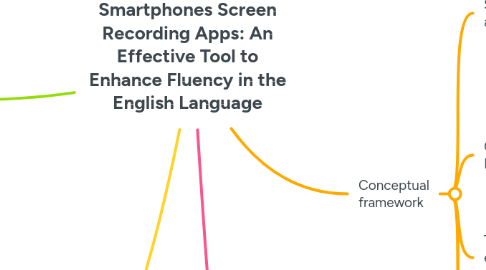
Smartphones Screen Recording Apps: An Effective Tool to Enhance Fluency in the English Language


1. Pardo Soto, C., & Cisterna Zenteno, C. (2019)
2. Introduction
2.1. Who?
2.1.1. 31 students from 7th Grade
2.2. What?
2.2.1. (Action Research) Implementation of a technology-based tool to the process of instruction of EFL
2.3. Where?
2.3.1. A subsidised primary school located in the area surrounding Concepción, Chile
3. Methodology
3.1. Participants
3.1.1. 31 students 12-13 years old 7th grade students Coronel, Chile 16 Male, 15 Female
3.2. Action Plan
3.2.1. Four sessions
3.2.1.1. Session 1 and 2
3.2.1.1.1. Students practised their oral delivery without the video recording tool
3.2.1.2. Session 3 and 4
3.2.1.2.1. Students used their smartphone video recording tools
3.2.1.3. The recorded video-clips were delivered by the students
3.3. Stage of action research plan
3.3.1. Plan Act Observe Reflect (McAteer, 2013)
3.3.2. Short dialogue of favorite TV show
3.4. Data collection techniques
3.4.1. Pre-speaking activity
3.4.1.1. The oral activity performance was assessed on an individual basis through the use of an adapted analytic rubric created by Zutell & Rasinski (1991)
3.4.1.1.1. Criteria
3.4.1.1.2. Levels of performance
3.4.2. Post-speaking activity
3.4.2.1. Groups of 3 to 4 students and as before, each student was required to speak fluently in English for about 30 seconds to 1 minute during the video recording related to the TV show
3.4.3. Focus group
3.4.3.1. 6 students
3.5. Data analysis techniques
3.5.1. Simple percentage analysis
3.5.2. Thematic analysis
4. Problem statement
4.1. (1998) MINEDUC, New curricula
4.1.1. Emphasis receptive skills leaving behind productive skills
4.2. TESTS
4.2.1. Measured listening and Reading skills
4.3. Fluency
4.3.1. Difficulty in speaking tasks
5. Conceptual framework
5.1. Smartphones video recording apps as a tool to improve oral fluency
5.1.1. Students can observe their own performances and those of their friends
5.1.2. They can see the videos and conceptualize and rehearse improvements.
5.2. Oral fluency development in the English language
5.2.1. Fluency is defined as the ability to achieve the communicative intent without too much hesitation and too many pauses (Crystal, 1977; Byne, 1986; Nation, 1991)
5.2.1.1. 1.Expressions and volume (Schmidt, 1992, p.358) 2.Phrasing (Skehan, 2009) 3. Smoothness (Koponen & Riggenbash, 2000) 4.Pace (Zimmer, 2008)
5.3. The smart phone: a useful educational tool to support EFL classroom activities
5.3.1. The use of video recording APPs
5.4. The role of technology in EFL classroom
5.4.1. Integrate the use of the four C´s: Communication, critical thinking, creativity, collaboration (Sloan, 2015)
5.5. Mobile Assisted Language Learning (MALL)
5.5.1. Offer specific applications that support the development of EFL skills.
6. Conclusions and Recommendations
6.1. It is certainly necessary to guide students and to prepare educational institutions to incorporate technological devices to perform educational purposes
6.2. The video recordings must be supervised and monitored by the researcher in every session to avoid future technical difficulties that can affect the sound quality and thus the findings of fluency
7. Limitations of the study
7.1. 1. Number of mobile phones
7.2. 2. Technical difficulties
7.3. 3. The paucity of time for the intervention process
7.4. 4. Environments in which the recording sessions were held
8. Analysis and discussion of results
8.1. This outcome corroborates what many pieces of research have previously proposed (Gromik, 2017; Sihem, 2013; Baleghizadeh & Oladrostam, 2010; Keddie, 2018; Mercado, 2017) with regard to the benefits of students using smartphones and video cameras to record themselves.
8.2. Students were in general positively inclined toward the use of video recordings as a resource to improve their speaking fluency
9. Findings
9.1. Figure 1
9.1.1. Comparison of students’ speaking performance according to the Expression and Volume criteria.
9.2. Figure 2
9.2.1. Comparison of students’ speaking performance according to the Phrasing criterion.
9.3. Figure 3
9.3.1. Comparison of students’ speaking performance according to the Smoothness criterion.
9.4. Figure 4
9.4.1. Comparison of students’ speaking performance according to the Pace criteria.
9.5. The focus group interview
9.5.1. Dimension 1: Student opinions on the smart video recording app in improving English languagefluency
9.5.2. Dimension 2: The ease and difficulty of working with smartphone video recording applications
9.5.2.1. Easy: Editing
9.5.2.2. Difficult: The recording process