


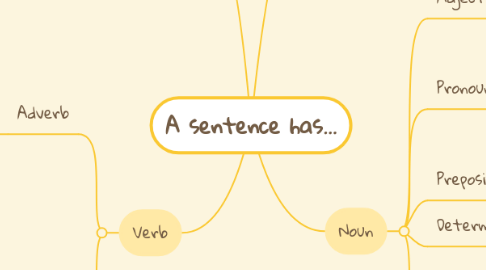
1. Verb
1.1. Adverb
1.1.1. Of time
1.1.1.1. Example: before, since.
1.1.2. Of frequency
1.1.2.1. Example: always, usually, never.
1.1.3. Of place
1.1.3.1. Example: here, near.
1.1.4. Of manner
1.1.4.1. Example: beautifully, loudly.
1.1.5. Of degree
1.1.5.1. Example: enough, almost
1.1.6. Of affirmation
1.1.6.1. Example: apparently, obviously.
1.2. Types
1.2.1. Transitive
1.2.1.1. Example: admire, love.
1.2.2. Intransitive
1.2.2.1. Example: work, talked.
1.2.3. Auxiliary
1.2.3.1. Be
1.2.3.2. Do
1.2.4. Modal
1.2.4.1. Example: can, may, might, should, could.
1.2.5. Irregular
1.2.5.1. They don't follow the -ed ending in past tense and past participle.
1.2.6. Phrasal
1.2.6.1. Is composed of a main verb and a preposition or adverb. Example: wake up, look after.
2. Exclamation/Interjection
2.1. Example: Congrats! Ow!
3. Noun
3.1. Adjective
3.1.1. Example: Pretty, smart.
3.2. Pronoun
3.2.1. Types
3.2.1.1. Subjective pronouns
3.2.1.1.1. Example: I, He.
3.2.1.2. Objective pronouns
3.2.1.2.1. Example: me, him.
3.2.1.3. Possessive pronouns
3.2.1.3.1. Example: mine, his.
3.2.1.4. Reflexive pronouns
3.2.1.4.1. Example: myself, himself.
3.3. Preposition
3.3.1. Example: Under, at.
3.4. Determiner
3.4.1. Example: a/an, the.
3.5. Types
3.5.1. Proper
3.5.1.1. Example: Marilyn, Mexico.
3.5.2. Common
3.5.2.1. Example: day, city.
3.5.3. Countable
3.5.3.1. Example: bottle, table.
3.5.4. Uncountable
3.5.4.1. Example: Water, bread.
3.5.5. Concrete
3.5.5.1. They can be seen, touched, smelled, heard or tasted. Example: dog, building.
3.5.6. Abstract
3.5.6.1. Things that cannot be seen or touched. Example: happiness, time.
3.5.7. Collective
3.5.7.1. Group of people or things. Example: family, team.
4. Conjunction
4.1. Coordinating
4.1.1. Example: FANBOYS.
4.2. Subordinating
4.2.1. Example: than, after, though, wherever, because, if, whichever, how.