


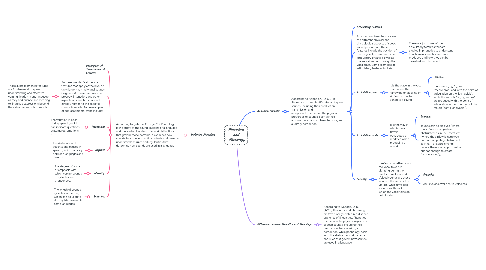
1. Definition Phonology
1.1. According to Iyabode, O. D. (2011), Phonology is the study of the sound patterns of a language and the abstract system of sound distinctions that govern those patterns. It examines how sounds function in specific contexts and seeks to understand the rules and regularities that determine how sounds are used in a language
1.1.1. Description of Suprasegmental Features
1.1.2. Suprasegmental features are features that apply at the level of units larger than individual sounds (segments). These features affect prosody, intonation, and other aspects of speech that are not directly related to the specific sounds in words. Some examples of suprasegmental traits include:
1.1.2.1. These suprasegmental features are fundamental to speech understanding and effective communication in any language, as they add nuance and meaning to linguistic expressions beyond the individual sounds of words.
1.1.3. Intonation:
1.1.3.1. The variation in pitch during speech, which can indicate questions, statements, emotions, etc.
1.1.4. Rhythm:
1.1.4.1. The distribution of accents and pauses in speech, which can vary between languages and dialects.
1.1.5. Intensity:
1.1.5.1. The degree of force or emphasis with which certain sounds or syllables are pronounced.
1.1.6. Duration:
1.1.6.1. The length of sounds, syllables, or pauses, which can be used to distinguish meaning in some languages.
2. Definition Phonetic
2.1. According to Iyabode, O. D. (2011), Phonetics is the scientific study of speech sounds, including their production, transmission and reception. It focuses on the physical properties of sounds, such as their articulation, acoustic characteristics, and auditory perception.
2.1.1. Articulatory Features
2.1.2. Articulatory characteristics are the different physical and physiological aspects of speech sound production. These features include the position of the tongue, lips, jaw, and other articulatory organs, as well as the way air moves through the vocal tract. Some examples of articulatory features include:
2.1.2.1. These are just some of the articulatory features that are studied in phonetics to understand how human speech sounds are produced and how they can be classified and described.
2.1.3. Articulation point:
2.1.3.1. It is the place in the vocal tract where the narrowing or blocking of air flow occurs to generate a sound
2.1.3.1.1. Example:
2.1.3.1.2. the sounds /p/, /b/, and /m/ are produced with the point of articulation on the lips (labials), while the sounds /t/, /d/, and /n/ are produced with the point of articulation in the front part of the mouth (dental or alveolar).
2.1.4. Articulation mode:
2.1.4.1. It is the way in which the air flow is obstructed or modified when producing a sound.
2.1.4.1.1. Example:
2.1.4.1.2. sounds can be plosives (where the airflow is completely obstructed, as in /p/), fricatives (where the airflow is narrowed but not completely obstructed, as in /s/), or approximants. (where there is an approximation but not enough to create friction, as in /l/).
2.1.5. Sonority:
2.1.5.1. It refers to whether or not the vocal folds are vibrating during the production of a sound. Voiced sounds are those in which the vocal folds vibrate, while unvoiced sounds are those in which the vocal folds do not vibrate
2.1.5.1.1. Example:
2.1.5.1.2. /b/ is voiced, while /p/ is voiceless.