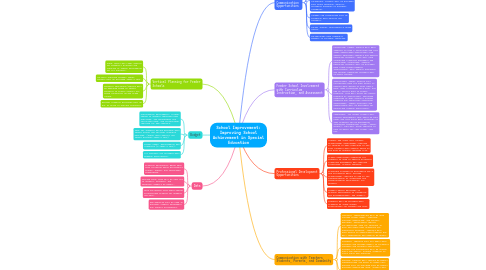
School Improvement: Improving School Achievement in Special Educationpar Lauren Harrison
1. Vertical Planning for Feeder Schools
1.1. Grade levels will meet monthly for mandatory planning and creating of common assessments for all subjects.
1.2. Vertical planning between feeder schools will be provided twice a year.
1.3. Resource Specialist/Coaches will be assigned based on feeder patterns to ensure schools are being consistent across grade levels.
1.4. Digital resource platforms will be put in place to provide resources.
2. Budget
2.1. Professional Development: Trainer needed to educate regarding best practices, IEP development and collecting data, and professional learning for new teachers.
2.2. Subs for teachers during meetings with feeder school and vertical planning meetings. (grade level monthly and feeder patterns twice a year)
2.3. Parent Night: Refreshments and resources (3 times a year).
2.4. All teachers are provided with Reading intervention.
3. Data
3.1. Progress Monitoring: Based upon data collected using proficiency scales, graphs, and formalized assessments.
3.2. Sharing Data: Data will be sent out to parents, students, and community members bi-weekly.
3.3. Data collection from state-vested intervention program for Reading and Math.
3.4. OBM measures will be used to document student engagement and student achievement.
4. Collaboration/ Communication Opportunities
4.1. Professional Leanring Communities will be established. This will assist in vertical collaboration. Monthly faculty meetings will be held.
4.2. Resource Specialist/Coach will meet with Special Education Teachers, bi-weekly.
4.3. A parent night will be held three times a year in order for parents to be informed about best practices and educational teaching strategies. Parents will be provided with video modeling, monthly, providing examples of academic standards.
4.4. Student-led conferences will be establish with parents and teachers.
4.5. Parent teacher conferences-3 times yearly.
4.6. Partnerships with community members to increase resources.
5. Feeder School Involvement with Curriculum, Instruction, and Assessment
5.1. Curriculum: Feeder schools will work together to plan a curriculum map that fuses specialized instruction from special education teachers and general education teachers. This will help streamline classroom managment and educational strategies. Special Education Teachers will be provided with state-vested Reading intervention. Both Special Education and General Education Teachers will co-teach lessons.
5.2. Instruction: Feeder schools will collaborate with the home school to discuss what worked or what didn't work, what strategies were used, and how to collect data to ensure progress. This will allow for better planning of instruction, including knowledge of what actively engages students and reinforces successful achievement. Common protocols and expectations will be developed for delivering reading instruction.
5.3. Assessment: The feeder schools will utilize assessments that build on each other and that align with standards so that progress can be documented throughout educational career (SPIRE, mClass). This will allow teachers to pick up where the last school left off.
6. Professional Development Opportunities
6.1. Teacher and Staff will receive professional development training in regards to best practices to use with students with special needs in the area of English Language Arts.
6.2. Create observation schedules for teachers in need to observe effective classroom management and teaching strategies. Provide feedback.
6.3. Providing training on developing IEP's and collecting data. Provide professional learning to aid in the implementation of strategies and differentiated instruction. AAC devices
6.4. Conduct parent workshops to provide information on standards, IEP accommodations, and support.
6.5. Teachers will be provided with training on state-vested intervention for Reading and Math.
7. Communication with Teachers, Students, Parents, and Community
7.1. Teachers: Communication will be done through school email, training, internal monitoring, and monthly meetings. Established regular collaboration time for teachers to plan and share best practices for supporting students. Teachers will have access to specialists/coaches who will communicate and observe bi-weekly.
7.2. Students: Teachers will set goals with students and provide weekly to bi-weekly feedback and progress monitoring. Student-led conferences will be hosted every few months. Prepare students to track their own progress.
7.3. Parents: Parents will receive bi-weekly communication via email or phone call. Parents will be provided with bi-weekly progress monitoring data. Schools will host information sessions/parents nights to inform parents of plan to improve achievement. Parents will have access to video-modeled lessons that can be taught at home.
7.4. Community: The community will have access to the school's website for basic information. The website will be updated bi-weekly. Community members will be invited to Curriculum Night, Parent Workshops, and more. Schools will partner with local businesses to access resources.