


1. Word Level
1.1. Defintion: The word level of phonological awareness is the process of children breaking up sentences into only words. Children learn how to blend, segment and manipulate different parts of a word to create new words (compound words).
1.2. Word Level Activities
1.2.1. Activity 1: Teacher will say a sentence or phrase from the set text. Children will need to use manipulatives to show how many words were in the sentences. The manipulatives for this activity will be using counters.
1.2.1.1. Examples of sentences/phrases from the text: • “And he sailed off through night and day” • “His mother called him “WILD THING!” • “That very night in Max’s room a forest grew”
1.2.2. Activity 2: This activity will be an alliteration activity. Alliteration is where a group of words have the same beginning sound. For this activity, the teacher will tell the children that they are going on Max’s boat to where the Wild Things are. To be allowed on Max’s boat each child needs to say the secret password. The secret password is any word that has the same beginning sound as Max.
1.2.2.1. Examples of secret passwords: • Markers • Mats • Marshmallows
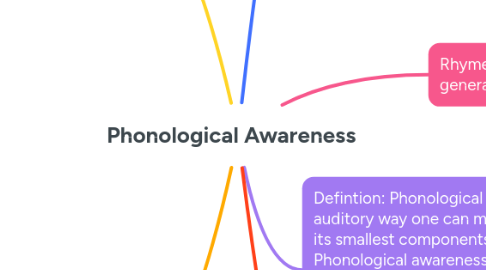
2. Defintion: Phonological awareness is the auditory way one can manipulate words to its smallest components in spoken form. Phonological awareness allows a person to develop different skills of listening and speaking different parts of a word. These skills are developing word, rhyming, syllable, onset- rime and phonemic awareness.
3. Rhyme Level - identification and generation
3.1. Definition: The rhyme level of phonological awareness is where children are able to learn how to identify and generate words that rhyme. This level focusses on children being able focus on individual words in a sentence and identifying what sounds in a word are different and/ or the same.
3.2. Rhyme Level Activties
3.2.1. Activity 1 Rhyme Identification: Teacher will have a plushie monster and this will be the rhyming Wild Thing. The teacher will pick two words that rhyme and one that does not from the text. When the teacher passes the rhyming Wild Thing to a child, they have to identify which two words rhyme and which word does not.
3.2.1.1. Examples of rhyming words from the text to give to children: • Teeth, weak, kind • Roar, claw, night • Thing, king, eye
3.2.2. Activity 2 Rhyme Generation: Teacher will point out to an object/thing on the illustration pages of the text. In small groups, children will need to work together to generate 3 rhyming words that rhyme with the image that the teacher points too. Each group will share their 3 rhyming words with the class.
3.2.2.1. For example: • Teacher points to a Wild Things toe. Possible words that rhyme with toe; bow, flow, crow. • Teacher points to Max’s crown. Possible words that rhyme with crown; brown, frown, town. • Teacher points to a Max’s boat. Possible words that rhyme with boat; float, coat, wrote.
4. Syllable Level
4.1. Definition: The syllable level of phonological awareness is where children begin to break words apart. Syllables are the single unbroken sounds that is in a word. This level teaches children how to segment and blend syllables together to create different words.
4.2. Syllable Level Activities
4.2.1. Activity 1: The teacher will have a selection of words from the text and the children will be broken up into groups of 4. The teacher will go around to each group and ask the children to clap out how many syllables they hear in their groups word. The teacher will model the first word with the whole class and then go around to each group with a different word.
4.2.1.1. Example of words: • Word 1: Rumpus – number of claps (syllables) = 2 • Word 2: Terrible – number of claps (syllables) = 3 • Word 3: Sail – number of claps (syllables) = 1
4.2.2. Activity 2: As a class, the teacher will say different words from the text and the class will work out how many syllables are in each word by stomping to the syllable. After stomping to each syllable of the word the teacher will ask the children to put two fingers under their chin. The children will then break the word into its syllables and stretch out the sounds of each syllable. The teacher will point out how their chins drop when there is a vowel sound in the word – demonstrating how each syllable is broken up by the vowel sounds.
4.2.2.1. Examples of words to use: • Magic • Frightened • Lonely
5. Phoneme Level
5.1. Definition: The phoneme level of phonological awareness is where children are breaking up a word into the smallest unit of sounds. This level enables children to segment, isolate, blend, manipulate, add, delete and substitute different sounds to create different words.
5.2. Phoneme Level Activites
5.2.1. Activity 1 Blending: The teacher will do a blending activity. This activity requires students to break words into their phonemes and blend them together to create the set word. For this activity, the teacher will have a selection of words from the text that they will read to the class. For each word, the teacher will direct children to ‘chop’ their arm up (going down their arm) for each phoneme they hear in the word and then blend the sounds by sliding their hand down their arm.
5.2.1.1. Examples of words and their phonemes: • Word 1: “day” o Phonemes: /d/-/ay/ • Word 2: “weeks” o Phonemes: /w/-/ee/-/k/-/s/ • Word 3: “sent” o Phonemes: /s/-/e/-/n/-/t/
5.2.2. Activity 2 Isolating: : The teacher will do an isolating activity. This activity requires children to isolate phonemes in a first, middle and final sound. For this activity, the teacher will have a selection of words from the text that will be read to the class individually. For each word, the teacher will ask students to repeat either the first, middle or last phoneme they hear in each word.
5.2.2.1. Examples of words and what phoneme is to be isolated: • Word 1: “yellow” o phoneme to be isolated and repeated: final = /ow/ • Word 2: “bed” o phoneme to be isolated and repeated: first = /b/ • Word 3: “night” o phoneme to be isolated and repeated: middle = /igh/
6. Onset-rime Level
6.1. Definition: The onset-rime level of phonological awareness is where children are introduced into breaking up sounds into beginning (onset) and end sounds (rime) of a word.
6.2. Onset-rime Level Activities
6.2.1. Activtiy 1: Teacher will have a mystery bag full of objects that are relevant to the set text. Children will be sitting in a circle and each child will have a turn of picking an object out of the mystery bag and saying the onset and rime of the object.
6.2.1.1. Examples of objects in mystery bag and their onset and rime: • Object: boat à onset = ‘b’ , rime = ‘oat’ • Object: crown à onset = ‘cr’ , rime = ‘own’ • Object: vine à onset = ‘v’ , rime = ‘ine’
6.2.2. Activity 2: Teacher will have a selection of words from the set text to read out to the class. The teacher will ask the class what the onset and rime of each word is. Once children identify the onset and rime the teacher will change the onset and ask the children to identify the new word.
6.2.2.1. For example: • Initial word: wall o Onset = ‘w’ , rime = ‘all’ o Change ‘w’ to ‘t’ – new word ‘tall’ • Initial word: vine o Onset = ‘v’ , rime = ‘ine’ o Change ‘v’ to ‘tw’ – new word ‘twine’ • Initial word: night o Onset = ‘n’ , rime = ‘ight’ o Change ‘n’ to ‘fr’ – new word ‘fright’