


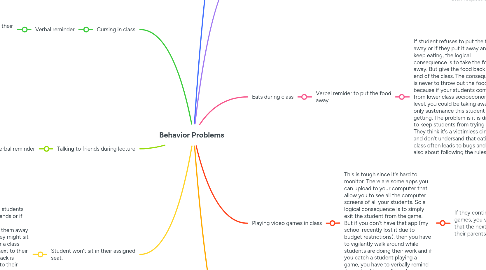
1. Cursing in class
1.1. Verbal reminder
1.1.1. If they do it again, you call their parents
1.1.1.1. If it continues, you call a parent teacher conference and you once again explain as you have already in the beginning of the year that you talk differently with different people and that students must liken the classroom to a board room in a coporation. You might be talking to your colleagues in the hallway about a TV show you watched the night before, but once you go into the board room for a meeting with your bosses, your language and demeanor must change and become more serious. That they must learn this for high school, college and then of course, jobs in the real world.
2. Talking to friends during lecture
2.1. Verbal reminder
2.1.1. If the student continues to talk and be disruptive during lecture, move the student to a seat in an area that may be less distracting. I know teachers who change the seating chart every week; the problem is, this is very time consuming.
2.1.1.1. If the student keeps on talking in their new seat, then you have them sit by themselves and finish their work there for the rest of the class. Next class, they'll return to their seat (the one you moved them to when they first talking to their friend). The sitting by themselves should not be in a corner or any place that can be seen as embarassing. Just a place where they can be distraction free.
3. Student won't sit in their assigned seat.
3.1. This happens a lot when students rae moved from their friends or if the class room seating arrangement simply has them away from their friends. So they might sit in their assigned seat for a class but then next class, sit next to their friend. Or when you're back is turned, they go sit next to their friend. You must have them go back to their seat and give them a verbal reminder that their parents will be called the next time this happens.
3.1.1. If it happens again, you contact the parents and explain that the student's grades are suffering because they're not paying attention and are allowing themselves to be distracted.
3.1.1.1. If it happens again, then you call a parent teacher conference for both you and the parents to explain to the student how them talking in class to their neighbor is taking away from their achievements in class. To logically explain how their behavior is hurting the student.
4. Takes cellphone out in class in a school where cellphones are never allowed other than kept in the students' backpacks all day.
4.1. If first offense, politely ask the student to put it away.
4.1.1. If not first offense, then request to take phone. Since this is not first offense, student has been told repeatedly that if a phone is seen out more than once, it will be taken away and given back to the student at the end of the class. This is a logical consequence. If first offense but student still does not put it away, then request to take phone.
4.1.1.1. If student does not hand phone over at this point, then teacher calls admin, who sends someone to take the phone from the student and then give it back to that student at the end of the day. Again, another logical consequence, as it has been explained to the student several times since the beginning of the school year and on the syllabus which they took home to get signed by their parents that these are the consequences of such actions with their phones during class.
4.1.1.1.1. If this happens more than once; that is, the phone is kept by admin until the end of the day, then parents will be called. All of this is my current school policy and I believe obides by the lessons of rules and consequences of this classroom management course.
5. Has earbuds in ears during class
5.1. If first offense, politely ask the student to put it away.
5.1.1. If not first offense, then request to take earbuds. Since this is not first offense, student has been told repeatedly that if an earbud is seen in a student's ear more than once, it will be taken away and given back to the student at the end of the class. This to me, is a logical consequence. If first offense but student still does not put it away, then request to take earbuds.
5.1.1.1. If student does not hand earbuds over at this point, then teacher calls admin, who sends someone to take the earbuds from the student and then give them back to that student at the end of the day. Again, another logical consequence, as it has been explained to the student several times since the beginning of the school year and on the syllabus which they took home to get signed by their parents that these are the consequences of such actions with their earbuds during class.
5.1.1.1.1. Earbuds are different from phones, as they are more difficult to hide. My school prohibits hoodies fully over the head so if a student has the hoodie on tight, most likely, they have their earbuds in. So earbuds are easy to discover and as much as students are attached, they're not as attached to them as to their phones. So there's less resistance to taking them. Therefore, it hardly ever gets to this stage, but if it does, if this happens more than once; that is, the earbuds are kept by admin until the end of the day, then parents will be called.
6. Eats during class
6.1. Verbal remider to put the food away.
6.1.1. If student refuses to put the food away or if they put it away and then keep eating, the logical consequence is to take the food away. But give the food back at the end of the class. The consequence is never to throw out the food because if your students come from lower class socioeconomic level, you could be taking away the only sustenance this student is getting. The problem is it is difficult to keep students from trying this. They think it's a victimless cime and don't undersand that eating in class often leads to bugs and it's also about following the rules.
6.1.1.1. If this becomes a chronic problem, you need to have a parent teacher conference to discuss the student not eating enough for breakfast or at lunch and why that is happening.
7. Playing video games in class
7.1. This is tough since it's hard to monitor. There are some apps you can upload to your computer that allow you to see all the computer screens of all your students. So a logical consequence is to simply exit the student from the game. But if you don't have that app (my school recently lost it due to budget restrictions), then you have to vigilantly walk around while students are doing their work and if you catch a student playing a game, you have to verbally remind them that it's not allowed.
7.1.1. If they continue playing their games, you verbally remind them that the next consequence is that their parents will be called.
7.1.1.1. If they continue to play video games during class, then you call the parents and schedule a parent teacher conference. In the conference, you get on the same page with the parents in explain how their child is not finishing assignments or getting a grade as good as they can be getting. That the student is hurting themselves through this behavior. You should also keep communication up with the parents.
7.1.1.1.1. If the student continues this behavior, even after the parent teacher conference, you keep emailing the parents and keep them updated on the students' behavior and how its affecting his work and grades.
8. Students taking too long out with the bathroom pass
8.1. Students will often take 20-30 minutes or even more, out with the bathroom pass. Sometimes students with actual emergencies can't go because the bathroom pass is being used (although I write them emergency passes -- technically, that's against school policy) And sometimes, these students walk around, looking for friends who are also out and about with their class bathroom pass and sometimes, they will enter other rooms to find friends and rile up teachers. I think you always have to start with a verbal reminder not to do it again.
8.1.1. But if the student does it again, you contact the parent and explain (to the student also) that the student is taking time away from students who have real emergencies and also that the student is responsible for the work missed during that time. The student didn't get a 0 for the day (that would just disencourage the student from trying at all), but the student will get a 0 for the day if the assignment doesn't get done in a reasonable amount of time (usually a week is good). This feels like a logical consequence because the student will get it explained to them by both the teacher and the student's parents that they are hurting their grades by taking all that time in the bathroom. And their grades should be important to them not just for the sake of getting an education but for practical reasons such as being able to participate in certain activities like sports and end of the year activities (for example: Grad-nite)