
2.1.a Engagement patterns of different social groups in physical activities and sports.

GCSE PE OCR 2.1.a Engagement patterns of different social groups in physical activities and sports.

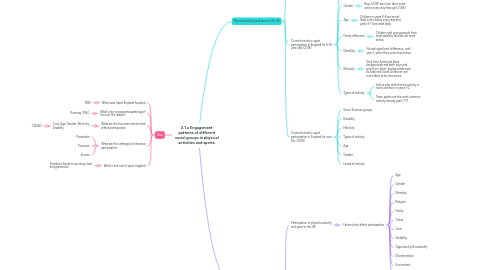
1. Quiz
1.1. When was Sport England founded
1.1.1. 1996
1.2. What is the most participated sport for over 16s (adults)
1.2.1. Running (15%)
1.3. What are the five main factors that affect participation
1.3.1. Cost, Age, Gender, Ethnicity, Disablity
1.3.1.1. CAGED
1.4. What are the strategies to improve participation
1.4.1. Promotion
1.4.2. Provision
1.4.3. Access
1.5. What is the role of sport england
1.5.1. Distribute funds to sporting clubs and grassroots.
2. Physical activity and sport in the UK
2.1. Organisations
2.1.1. National Governing Bodies (NGBs)
2.1.1.1. Independent organisations that govern each sport.
2.1.1.1.1. The FA
2.1.1.1.2. England Rugby
2.1.1.1.3. Swim England
2.1.1.1.4. England Netball
2.1.1.1.5. LTA Tennis For Britain
2.1.2. Department of Culture, Media and Sport (DCMS)
2.1.2.1. The Department for Digital, Culture, MEdia & Sport (DCMS) helps drive growth, enrich lives and promote the UK. Supported by 45 agencies and public bodies. It protects and promtes Britain's cultural and artistic heritage.
2.1.3. Sport England
2.1.3.1. Sport England helps people and communities across the country get a sporting habit for life. It is a non-departmental public body that distributes funds from the Treasury (via the DCMS) and the National Lottery. Since being established in 1996, Sport England has invested over £2 Billion of Lottery funds and £300million from the Exchequer into Sports in England.
2.2. Current trends in sport participation in England for 5-16 year olds (2018)
2.2.1. Levels of activity
2.2.1.1. 32.9% do less than 30 minutes a day; 17.5% do 60 minutes or more every day.
2.2.2. Gender
2.2.2.1. Boys (20%) are more likely to be active every day than girls (14%)
2.2.3. Age
2.2.3.1. Children in years 5-8 are morst likely to be active every day and years 9-11 are least likely
2.2.4. Family affluence
2.2.4.1. Children and young people from most wealthy families are more active.
2.2.5. Disability
2.2.5.1. No real significant difference, until year 7, when they come less active.
2.2.6. Ethnicity
2.2.6.1. Girls from Asian and black backgrounds and both boys and girls from 'other' backgrounds such as Arab and South American, are more likely to be less active.
2.2.7. Types of activity
2.2.7.1. Active play and informe activity is most common in years 1-2
2.2.7.2. Team sports are the most common activity among years 7-11
2.3. Current trends in sport participation in England for over 16s (2018)
2.3.1. Socio-Econmic groups
2.3.2. Disability
2.3.3. Ethnicity
2.3.4. Types of activity
2.3.5. Age
2.3.6. Gender
2.3.7. Levels of activity
3. Participation in physical activity and sport
3.1. Participation of physicla activity and sport in the UK
3.1.1. Factors that affect participation
3.1.1.1. Age
3.1.1.2. Gender
3.1.1.3. Ethnicity
3.1.1.4. Religion
3.1.1.5. Family
3.1.1.6. Tinme
3.1.1.7. Cost
3.1.1.8. Disability
3.1.1.9. Opportunity/Accsesibilty
3.1.1.10. Discrimination
3.1.1.11. Enviroment
3.1.1.12. Media coverage
3.2. Participation in top 15 sport activities for over 16s (adults)
3.2.1. Running
3.2.1.1. 15%
3.2.2. Fitness class
3.2.2.1. 14%
3.2.3. Gym session
3.2.3.1. 12%
3.2.4. Swimming
3.2.4.1. 11%
3.2.5. Exercise machines
3.2.6. Climbing or mountaneering
3.2.7. Interval sessions
3.2.8. Football
3.2.9. Weights session
3.2.10. Generic fitness training
3.3. Strategies to improve participation.
3.3.1. Promotion
3.3.1.1. Convincing people to take up sport
3.3.2. Provision
3.3.2.1. Facilities
3.3.3. Access
3.3.3.1. Opportunity to participate.