
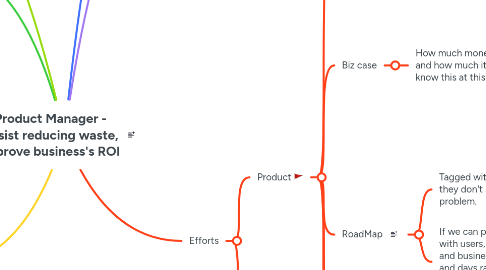
Product Manager - Assist reducing waste, improve business's ROI

Researching on how to improve tech product businesses ROI (Return in Investment)

1. Responsibilities
1.1. Deep Knowledge of customers
1.1.1. B2C
1.1.1.1. Expert of the customers issues, pains, desires, how they think...
1.1.2. B2B
1.1.2.1. How they work
1.1.2.2. How they decide to buy
1.2. Deep Knowledge of the data
1.2.1. Sales and usage analytics
1.2.2. Result of A/B testing
1.3. Deep knowledge of the business
1.4. Deep knowledge of market and industry
1.4.1. Having a great UX design for a B2B product is one of the best competitive differentiator
2. Core
2.1. Behind every great product there is usually someone behind the scene, working tiredlessly who led the product team to combine technology and design, to solve real customer problems in a way that met the needs of the business.
3. Influence
3.1. Failure rate of technology products/startups
3.1.1. Startups - **Product Discovery**
3.1.2. Growth Stage - **Scaling**
3.1.3. Enterprise - **Consistent Innovation**
4. Outcome-based-Roadmaps
4.1. Step 1: Validate solution with customers for necessary value and usability
4.2. Step 2: Validate with engineering team for feasibility
4.3. Step 3: Validate with business stakeholders for business viability
4.4. Step 4: get to know when your team can deliver and expected outcome
5. comprehensive analysis of stakeholders feedback, highlighting urgent themes, urgency levels, emerging trends, and customer sentiments.
6. Efforts
6.1. Product :triangular_flag_on_post:
6.1.1. Ideas
6.1.1.1. Sales and stakeholder driven ideas
6.1.1.1.1. Encourge mercenaries culture rather than missionaries culture
6.1.1.1.2. Lack of team empowerment
6.1.2. Biz case
6.1.2.1. How much money you can make and how much it will cost? Can we know this at this point?
6.1.2.1.1. No, we can't know this at this point. Why?
6.1.3. RoadMap
6.1.3.1. Tagged with committments even if they don't solve any underlining problem.
6.1.3.2. If we can prototype and test ideas with users, customers, engineers and business stakeholders in hours and days rather then weeks and months, it changes the dynamics and the result.
6.1.4. Requirements
6.1.5. Design
6.1.6. Build
6.1.7. Test
6.1.8. Deploy
6.2. Lean Product :100:
6.2.1. Risks should be tackled upfront
6.2.2. Product/Feature should be defined collaboratively rather then sequentially.
6.2.3. Solving Problems not implementing features
7. Action Plan
7.1. Step 1: Choose a problem statement
7.2. Step 2: Need six B2B customer all from a single target market.
7.3. Step 3: Be the technology partner for 6 customers and make a beta user community
7.4. Step 4: Build a generic product making sure it solve all six customers underlining problem.
7.5. Step 5: Release the product in market
7.6. Step 6: Keep a closed loop for these 6 customer, understand their needs and always give them early access to new features, so that when we release they will love our solution.
8. Product Discovery
8.1. Companies needs some type of system to rate the ideas
8.2. Separate good ideas from bad
8.2.1. Validated Product Backlog