


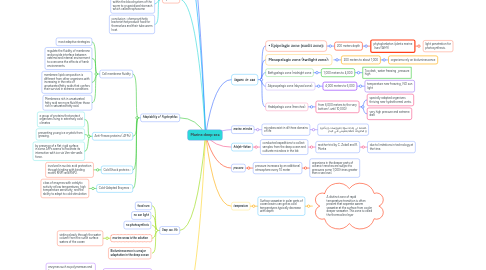
1. thermocline layer
1.1. start at around 100 meters thick
1.1.1. below the thermocline From there the temperature drops very gradually with increasing depth.
2. Light adaptations of MOC,s
2.1. specialized adaptations to survive in low-light conditions
2.2. Some have developed bioluminescence
2.3. while others utilize alternative energy sources like chemosynthesis
3. symbiosis
3.1. giant tube worm have no trace of a digestive system
3.2. bacteria helps it by absorb hydrogen sulphide and oxygen from their surroundings
3.3. chemicals are then transported within the blood system of the worm to a specialized stomach which called trophosome
3.4. conclusion : chemosynthetic bacteria that produce food for themselves and their tube worm host.
4. Adaptability of Psychrophiles
4.1. Cell membrane fluidity
4.1.1. most adaptive strategies
4.1.2. regulate the fluidity of membrane and provide interface between external and internal environment to overcome the effects of harsh environments.
4.1.3. membrane lipid composition is different from other organisms with increasing in the ratio of unsaturated fatty acids that confers their survival in extreme conditions
4.1.4. Membranes rich in unsaturated fatty acid are more fluid than those rich in saturated fatty acid.
4.2. Anti-Freeze proteins ( AFPs)
4.2.1. a group of proteins that protect organisms living in extremely cold climates
4.2.2. preventing young ice crystals from growing.
4.2.3. by presence of a flat, rigid surface in some AFPs seems to facilitate its interaction with ice via Van-der-walls force .
4.3. Cold Shock proteins :
4.3.1. involved in nucleic acid protection through binding with binding motifs RNP1 and RNP2.
4.4. Cold-Adapted Enzymes :
4.4.1. class of enzymes with catalytic activity at low temperatures, high temperature sensitivity, and the ability to adapt to cold stimulation
5. Deep sea life
5.1. food rare
5.2. no sun light
5.3. no photosyntheis
5.4. marine snow is the solution
5.4.1. sinking slowly through the water column from the sunlit surface waters of the ocean
5.5. Bioluminescence is a major adaptation in the deep ocean
6. Applications
6.1. Biotechnology and Pharmaceutical Industry
6.1.1. enzymes such as polymerases and ligases sourced from deep sea bacteria are used in molecular biology techniques like PCR
6.2. Bioremediation:
6.2.1. bacteria are adept at breaking down pollutants found in deep sea environments.
6.3. Nutrient Cycling
6.3.1. They contribute to the breakdown of organic matter, recycling nutrients such as nitrogen, carbon, and sulfur.
6.4. Drug Discovery
6.4.1. these bacteria for potential drug discovery, aiming to find compounds with antimicrobial, anticancer, or other therapeutic properties.
6.5. Biomineralization
6.5.1. they precipitate minerals such as calcium carbonate
7. layers in sea
7.1. • Epipelagic zone (sunlit zone):
7.1.1. 200 meters depth
7.1.1.1. phytoplanketon /plants marine lives (WHY)
7.1.1.1.1. light penetration for photosynthesis.
7.2. Mesopelagic zone (twilight zone):
7.2.1. 200 meters to about 1,000
7.2.1.1. organisms rely on bioluminescence
7.3. Bathypelagic zone (midnight zone
7.3.1. 1,000 meters to 4,000
7.3.1.1. Too dark , water freezing , pressure high
7.4. Abyssopelagic zone (abyssal zone):
7.4.1. 4,000 meters to 6,000
7.4.1.1. temperature near freezing , NO sun light
7.5. Hadalpelagic zone (trenches):
7.5.1. from 6,000 meters to the very bottom ( until 10,000)
7.5.1.1. specially adapted organisms thriving near hydrothermal vents.
7.5.1.2. very high pressure and extreme dark
8. marine microbe
8.1. microbes exist in all three domains of life
8.1.1. خلاصه اي حاجه سواء فيروسات و بكتريا و فطريات كلها بتعيش في البحر
9. Adolph-Adrien
9.1. conducted expeditions to collect samples from the deep ocean and cultivate microbes in the lab
9.1.1. another trial by C. Zobell and R. Morita
9.1.1.1. due to limitations in technology at the time.
10. pressure
10.1. pressure increases by an additional atmosphere every 10 meter
10.1.1. organisms in the deeper parts of oceanic trenches are subject to pressures some 1,000 times greater than a sea level.
11. temperature
11.1. Surface seawater in polar parts of ocean basins can get as cold temperatures typically decrease with depth
11.1.1. A distinct zone of rapid temperature transition is often present that separate swarm seawater at the surface from cooler deeper seawater. This zone is called the thermocline layer