

Java SE 11 Programmer I 1Z0-815
par Dave Turner
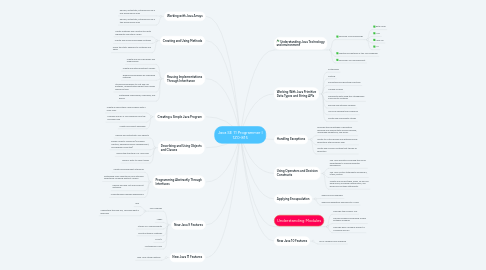
1. Working with Java Arrays
1.1. Declare, instantiate, initialize and use a one-dimensional array
1.2. Declare, instantiate, initialize and use a two-dimensional array
2. Creating and Using Methods
2.1. Create methods and constructors with arguments and return values
2.2. Create and invoke overloaded methods
2.3. Apply the static keyword to methods and fields
3. Reusing Implementations Through Inheritance
3.1. Create and use subclasses and superclasses
3.2. Create and extend abstract classes
3.3. Enable polymorphism by overriding methods
3.4. Utilize polymorphism to cast and call methods, differentiating object type versus reference type
3.5. Distinguish overloading, overriding, and hiding
4. Creating a Simple Java Program
4.1. Create an executable Java program with a main class
4.2. Compile and run a Java program from the command line
4.3. Create and import packages
5. Describing and Using Objects and Classes
5.1. Declare and instantiate Java objects
5.2. Explain objects' lifecycles (including creation, dereferencing by reassignment, and garbage collection)
5.3. Define the structure of a Java class
5.4. Read or write to object fields
6. Programming Abstractly Through Interfaces
6.1. Create and implement interfaces
6.2. Distinguish class inheritance from interface inheritance including abstract classes
6.3. Declare and use List and ArrayList instances
6.4. Understanding Lambda Expressions
7. New Java 9 Features
7.1. Java Modules
7.1.1. jlink
7.1.2. Understand the new org, example what is java.base
7.2. JShell
7.3. Stream API Improvements
7.4. Private Interface Methods
7.5. HTTP/2
7.6. MultiRelease JARS
8. New Java 11 Features
8.1. New Java String Features
9. Understanding Java Technology and environment
9.1. Describe Java Technology
9.1.1. Byte Code
9.1.2. JVM
9.1.3. Java API
9.1.4. JIT