


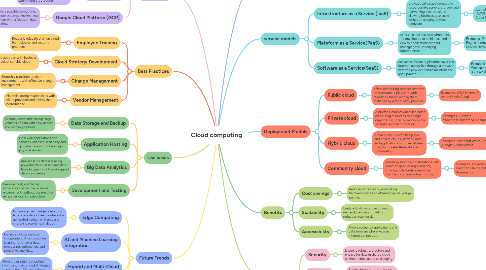
1. Key provides
1.1. Amazon Web Services (AWS)
1.1.1. Offers a wide range of cloud services for computing, storage, and analytics with extensive global coverage.
1.2. Microsoft Azure
1.2.1. Provides diverse cloud solutions including virtual machines and app hosting, with strong integration with Microsoft products.
1.3. Google Cloud Platform (GCP)
1.3.1. Delivers scalable computing, storage, and machine learning services with a focus on data analytics.
2. Best Practices
2.1. Employee Training
2.1.1. Regularly educate staff on cloud technologies and security practices.
2.2. Cloud Strategy Development
2.2.1. Align cloud adoption with business goals and select suitable cloud models.
2.3. Change Management
2.3.1. Smoothly transition to cloud environments with effective change management.
2.4. Vendor Management
2.4.1. Maintain strong relationships with cloud providers and review their performance.
3. Use cases
3.1. Data Storage and Backup
3.1.1. Securely store and backup large volumes of data with easy access and recovery options.
3.2. Application Hosting
3.2.1. Host web applications and services, enabling scalability and global access without managing physical servers.
3.3. Big Data Analytics
3.3.1. Analyze large datasets using powerful cloud-based analytics tools to gain insights and support decision-making.
3.4. Development and Testing
3.4.1. Develop, test, and deploy applications in flexible, scalable environments without the need for extensive local infrastructure.
4. Future Trends
4.1. Edge Computing
4.1.1. Increasing use of edge computing to process data closer to where it is generated, reducing latency and improving real-time analytics.
4.2. AI and Machine Learning Integration
4.2.1. Enhanced cloud services incorporating AI and machine learning for smarter data processing, automation, and predictive analytics.
4.3. Hybrid and Multi-Cloud Environments
4.3.1. More organizations adopting hybrid and multi-cloud strategies to combine public and private clouds, optimizing flexibility and avoiding vendor lock-in.
4.4. Increased Security and Privacy Solutions
4.4.1. Development of advanced security and privacy measures, including improved encryption, identity management, and compliance tools to address growing concerns.
5. Definition
5.1. Cloud computing provides on-demand access to computing resources like storage, servers, and applications over the internet, eliminating the need for local infrastructure.
6. service models
6.1. Infrastructure as a Service (IaaS)
6.1.1. provides virtualized computing resources like servers, storage, and networking over the cloud, allowing businesses to scale without managing physical hardware.
6.1.1.1. Examples : Amazon Web Services (AWS) ,Microsoft Azure,Google Cloud Platform (GCP).
6.2. Plateform as a Service(PaaS)
6.2.1. offers a cloud-based environment for developers to build, test, and deploy applications without managing the underlying infrastructure.
6.2.1.1. Examples : Google App Engine,Microsoft Azure App Service,Heroku.
6.3. Software as a Service(SaaS)
6.3.1. delivers software applications over the internet, accessible through a browser, with the provider handle maintenance and updates.
6.3.1.1. Examples : Google Workspace,Microsoft 365,Salesforce.
7. Deployment Models
7.1. Public cloud
7.1.1. offers computing services over the internet tomultiple users, with resources shared among them, managed by a third-party provider.
7.1.1.1. Examples : AWS,Microsoft Azure,Oracle Cloud
7.2. Private cloud
7.2.1. A private cloud provides dedicated computing resources to a single organization, offering more control, security, and customization.
7.2.1.1. Examples : VMware vSphere,Microsoft Azure Stack .
7.3. Hybrid cloud
7.3.1. A hybrid cloud combines public and private clouds, allowing data and applications to move between them for greater flexibility and optimization.
7.3.1.1. Examples : Microsoft Azure Arc,AWS Outposts ,Google Cloud Anthos.
7.4. Community cloud
7.4.1. shared by multiple organizations with common goals or requirements, offering collaborative use while maintaining shared infrastructure.
7.4.1.1. Examples : Government Cloud, Eduction Cloud,Health Data Aggregation.
8. Benefits
8.1. Cost savings
8.1.1. Reduces expenses by eliminating hardware costs and offering pay-as-you-go pricing.
8.2. Scalability
8.2.1. Easily adjusts resources to match demand, handling growth or reduction seamlessly.
8.3. Accessibility
8.3.1. Allows access to applications and data from anywhere with an internet connection.
9. Challenges
9.1. Security
9.1.1. Ensuring robust protection and privacy for data in shared cloud environments can be challenging.
9.2. Downtime
9.2.1. Service interruptions may occur, potentially impacting business operations.
9.3. Compliance
9.3.1. Navigating and adhering to regulatory requirements for data handling and storage can be complex.