


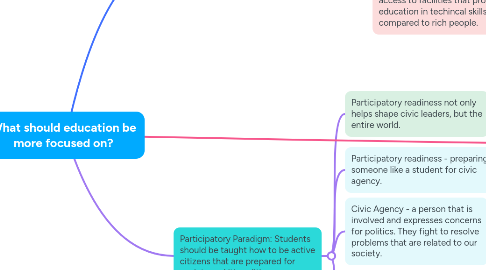
1. Vocational Paradigm: Students should be prepapred for practical jobs, trades, and basic techincal skills.
1.1. Preparing students for the workforce is important because those are the skills are needed in the world right now.
1.2. Contradictory, this idea actually promotes more inequality in the workforce. People from low-income backgrounds don't have as much access to facilities that provide education in techincal skills compared to rich people.
1.2.1. The article, "What is Education for?" by Danielle Allen comes foward with this point by refrencing Thomas Pikettys ideas. Pikkety advocates for the vocational paradigm, but also mentions how "educational institutions should be made broadly accessible; elite institutions, which serve mainly privileged youth from the highest income brackets, should draw students from other backgrounds"(Allen,6). Here, It's clearly seen how the vocational paradigm on it's own does not provide fairness. It can lead to meritocracy, which can end up being discriminatory.
2. Participatory Paradigm: Students should be taught how to be active citizens that are prepared for society and it's politics.
2.1. Participatory readiness not only helps shape civic leaders, but the entire world.
2.1.1. Students should not just be prepared to work, but also to be members of our society that can create change.
2.2. Participatory readiness - preparing someone like a student for civic agency.
2.3. Civic Agency - a person that is involved and expresses concerns for politics. They fight to resolve problems that are related to our society.
2.4. Democracy is created through teachings of humanities and social sciences.
2.4.1. Without the participatory paradigm, the economic inquality in the world will worsen. In order to prevent this, politcally engaging courses need to be included in students' curriculums as well. Positive effects of participatory readiness have been seen before,"The expansion of political participation drove egalitarian economic reforms in Britain in the nineteenth century and the United States in the early twentieth"(Allen,8). Through more political education in schools, citizens can be more involved and make better judgements.