


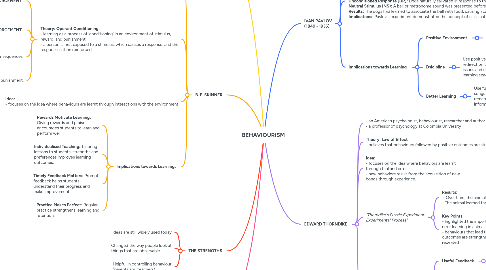
1. DEFINITION
1.1. A psychological theory that studies human behaviour through observable actions and their consequences. It emphasises learning through associations, reinforcement, and punishment.
2. B. F. SKINNER
2.1. - an American psychologist, behaviourist, author, inventor, and social philosopher - was a professor of psychology at Harvard University
2.2. **Theory: Operant Conditioning** - learning as a process of 'conditioning' in an environment of stimulus, reward, and punishment. - a person is first exposed to a stimulus, which causes a response, and the response is then reinforced.
2.2.1. **POSITIVE REINFORCEMENT**
2.2.1.1. - Skinner placed a hungry rat into a box that contained a lever. - As the rat scurried around inside the box, it would accidentally press the lever, causing a food pellet to drop into the box. - Thus, the rat can eat the food pellet.
2.2.2. **NEGATIVE REINFORCEMENT**
2.2.2.1. - A rat is placed in his Skinner box and then subjecting it to an unpleasant electric current which caused it some discomfort. - As the rat moved about the box it would accidentally knock the lever. - The current will cut off if the lever is pressed.
2.2.3. **Results:** - Through operant conditioning, animals learned to associate specific actions with consequences. - Over time, the animals displayed more purposeful and goal-directed behaviors
2.2.4. **Key Points:** - Skinner's operant conditioning experiment demonstrated how behavior could be modified and shaped through reinforcement and punishment. - The principles of operant conditioning are widely used in education promote desired behaviours and reduce undesired ones.
2.3. **Idea:** - focuses on the idea where behaviours are learnt through interactions with the environment
2.4. **Implications towards Learning:**
2.4.1. **Rewards Motivate Learning:** Giving rewards and praise encourages students to learn and perform well.
2.4.2. **Individualised Teaching:** Tailoring lessons to students' strengths and preferences improves learning outcomes.
2.4.3. **Timely Feedback Matters:** Prompt feedback helps students understand their progress and make improvements.
2.4.4. **Practice Makes Perfect:** Regular practice strengthens learning and retention.
3. THE STRENGTHS
3.1. Ideas are still widely used today
3.2. Changed the way people look at things that are observable
3.3. Helpful in controlling behaviour (parents and teachers)
4. THE WEAKNESSES
4.1. Uses assumptions
4.2. Treat people like controllable objects
4.3. Doesn't always work
5. IVAN PAVLOV (1849 - 1936)
5.1. a Russian physiologist and psychologist, renowned for his work in classical conditioning
5.2. **Theory: Classical Conditioning** - learning occurs through the association of stimuli and responses
5.3. **Objective:** To study the process of classical conditioning in dogs. **Experimental setup:** Pavlov used a group of dogs as subjects. **Unconditioned Stimulus (US):** Food presented to thedogs. **Unconditioned Response (UR):** Dogs naturally salivated in response to the food. **Neutral Stimulus (NS):** A bell or metronome sound was presented before giving food. **Results:** The dogs had learned to associate the bell with food, causing aconditioned response of salivation even without food being presented. **Implications:** Pavlov's experiment demonstrated the concept of classical conditioning, where a neutral stimulus can become associated with a meaningful stimulus, leading to a learned response.
5.4. **Implications towards Learning**
5.4.1. Positive Environment
5.4.1.1. Create a positive classroom atmosphere using rewards and praise to encourage good behavior and motivation.
5.4.2. Dsicipline
5.4.2.1. Use positive reinforcement and redirection to address behavior issues and maintain a conducive learning space.
5.4.3. Better Learning
5.4.3.1. Use fun and engaging tools like songs or visuals to help students remember and understand new information.
6. EDWARD THORNDIKE
6.1. - an American psychologist, behaviourist, researcher and author - a professor of psychology at Colombia University
6.2. **Theory: Law of Effect** - believes that behaviours followed by positive outcomes are strengthened, while those with negative consequences are weakened.
6.3. **Idea:** - focuses on the idea where behaviors are learnt through trial and error. - new behaviors result from the acquisition of new bonds through experience.
6.4. *"Thorndike's Puzzle Experiment: Experimental Process" *
6.4.1. **Results:** - Over time, the animal's escape actions became quicker and more purposeful. - The animal learned the specific action required to open the door and reach for the food.
6.4.2. **Key Points:** - highlighted the importance of trial and error learning in animals - behaviours that lead to positive outcomes are strengthened and repeated
6.5. Implications towards learning
6.5.1. **Useful Feedback**
6.5.1.1. Providing helpful feedback helps learners improve and retain knowledge.
6.5.2. **Personalised Learning**
6.5.2.1. Tailoring teaching to individual preferences and strengths boosts learning.
6.5.3. **Engaging Content**
6.5.3.1. Interesting and relevant material improves learning outcomes.
6.5.4. **Practice Matters**
6.5.4.1. Practice and repetition reinforce learning.