Phonetics and phonology: learners will be able to understand the phonetic and ...

Lancez-Vous. C'est gratuit
ou s'inscrire avec votre adresse e-mail
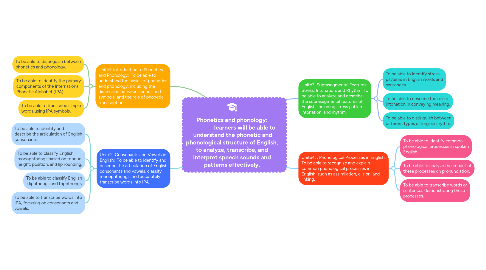
Phonetics and phonology: learners will be able to understand the phonetic and phonological structure of English, to analyze, transcribe, and interpret speech sounds and patterns effectively. par Mind Map: Phonetics and phonology:                   learners will be able to  understand the phonetic and phonological structure of English, to analyze, transcribe, and interpret speech sounds and patterns effectively.

1. Unité1: Introduction to Phonetics and Phonology: To be able to understand the basics of phonetics and phonology, including the distinction between sounds and symbols, and the role of phonetic transcription.

1.1. To be able to distinguish between phonetics and phonology.

1.2. To be able to identify the primary components of the International Phonetic Alphabet (IPA).

1.3. To be able to transcribe simple words using IPA symbols.

2. Unité2: Consonants and Vowels in English: To be able to identify and describe the articulation of English consonants and vowels, classify monophthongs, and accurately transcribe words into IPA.

2.1. To be able to identify and describe the articulation of English consonants.

2.2. To be able to classify English monophthongs based on tongue height, position, and lip rounding.

2.3. To be able to classify English diphthongs and triphthongs

2.4. To be able to transcribe words into IPA, focusing on consonants and vowels.

3. Unité3: Suprasegmental Features: Stress, Intonation, and Rhythm To be able to analyze and describe the suprasegmental features of English, including stress patterns, intonation, and rhythm.

3.1. To be able to identify stress patterns in English words and sentences.

3.2. To be able to describe the role of intonation in conveying meaning.

3.3. To be able to distinguish between different types of English rhythm.

4. Unité4: : Phonological Processes in English: To be able to recognize and explain common phonological processes in English, such as assimilation, elision, and linking.

4.1. To be able to identify common phonological processes in spoken English.

4.2. To be able to analyze the impact of these processes on pronunciation.

4.3. To be able to transcribe words or sentences demonstrating these processes.