Unlock the full potential of your projects.
Try MeisterTask for free.
Vous n'avez pas de compte ?
Inscription gratuite
Parcourir
Cartes en vedette
Catégories
Gestion de projet
Objectifs d'affaires
Ressources humaines
Brainstorming et analyse
Marketing et contenu
Éducation et remarques
Loisirs
Vie courante
Technologie
Design
Résumés
Autre
Langues
English
Deutsch
Français
Español
Português
Nederlands
Dansk
Русский
日本語
Italiano
简体中文
한국어
Autre
Montrer carte totale
Copier éditer carte
Copier
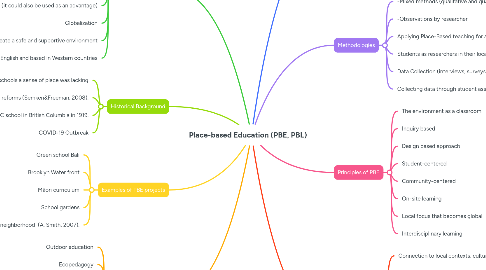
Place-based Education (PBE, PBL)
Autre
Silvana Rhoads
Suivre
Lancez-Vous.
C'est gratuit
S'inscrire avec Google
ou
s'inscrire
avec votre adresse e-mail
Cartes mentales similaires
Plan de carte mentale
Place-based Education (PBE, PBL)
par
Silvana Rhoads
1. Challenges of PBE
1.1. More support from bigger organizations and policymakers is needed
1.2. Not used in a global scale
1.3. Not widely practiced due to traditional school having defined curriculums with no place for change
1.4. Teachers not relying on experts in the field
1.5. The environment can’t be controlled or manipulated
1.6. Increase in technology (it could also be used as an advantage)
1.7. Globalization
1.8. Failure to create a safe and supportive environment
1.9. Most sources of PBE are in English and based in Western countries
2. Historical Background
2.1. At urban schools a sense of place was lacking
2.2. -It started being popular in the 90’s to fight Neoliberalism and educational reforms (Semken&Freeman, 2008).
2.3. The EC school in British Columbia in 1919.
2.4. COVID-19 Outbreak
3. Examples of PBE projects
3.1. Green school Bali
3.2. Brooklyn Water front
3.3. Māori curriculum
3.4. School gardens
3.5. Greater Egleston Community High School: Students worked on improving air quality in their neighborhood (A. Smith, 2007).
4. Connected theories
4.1. Outdoor education
4.2. Ecopedagogy
4.3. Pedagogy of the oppressed Paulo Freire, 1968
4.4. Sense of place theory
4.5. Culturally responsive teaching Hammond, 2018
4.6. Experiential learning John Dewey, 1938
4.7. Mutual Aid Kropotkin, 1902
5. Purpose
5.1. “deconstruct existing oppressive relationships” (Seawright, 2014)
5.2. Foster community-oriented citizens
5.3. Develop collaborative work between humans in a specific place
5.4. Expand students view of the world and foster their engagement
5.5. Understand relationships between humans and nature (Orr, 1992; G. Smith and Williams, 1999; Sobel, 2004)
5.6. Decolonize and deconstruct
5.7. “Develop future citizens that generate sustainable solutions to environmental, social, and economic problems”, (UNESCO, 2007).
6. Methodologies
6.1. -Mixed methods (qualitative and quantitative)
6.2. -Observations by researcher
6.3. Applying Place-Based teaching for a span of 10 weeks, by the teacher.
6.4. Students as researchers in their local community
6.5. Data Collection (interviews, surveys, questionnaires, observation diaries, document analysis)
6.6. Collecting data through student assignments on PBE and reflective diaries
7. Principles of PBE
7.1. The environment as a classroom
7.2. Inquiry based
7.3. Design based approach
7.4. Student-centered
7.5. Community-centered
7.6. On-site learning
7.7. Local focus that becomes global
7.8. Interdisciplinary learning
8. Benefits of PBE
8.1. Connection to local contexts, cultures and environments (Gruenewald, 2003a; Smith, 2002; Sobel, 2004; Orr, 2013)
8.2. Students identify and act on issues from their local areas (Smith and Sobel, 2010)
8.3. Deepens engagement (Smith, 2002)
8.4. Smith, 2002, “PBE acknowledges the lived experiences of students in a way that classroom learning does not”
8.5. Develops team work and awareness of one’s own environment
8.6. Deepens imagination
8.7. Promotes problem-solving and critical thinking skills in students
8.8. Makes education relevant
8.9. Creates active citizens
Lancez-vous. C'est gratuit!
Connectez-vous avec Google
ou
S'inscrire