


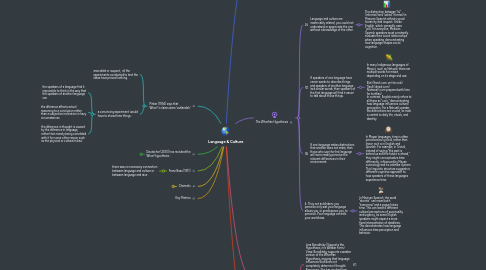
1. Pinker (1994) says that Whorf ’s claims were ‘outlandish’
1.1. anecdotal or suspect, all the experiments conducted to test the ideas have proved nothing.
1.2. a convincing experiment ‘would have to show three things:
1.2.1. the speakers of a language find it impossible to think in the way that the speakers of another language can
1.2.2. the diference affects actual reasoning to a conclusion rather than a subjective inclination in hazy circumstances
1.2.3. the diference in thought is caused by the diference in language, rather than merely being correlated with it for some other reason such as the physical or cultural milieu.’
2. Deutscher (2010) has revisited the Whorf hypothesis
2.1. ‘If the inventory of readymade words in your language determined which concepts you were able to understand, how would you ever learn anything new?
2.2. discusses some recent research which provides evidence for the connection between language and worldview
2.2.1. Australian aboriginal tongue Guugu Yimithirr, from north Queensland
2.3. urge readers to recognize how deeply encoded some sociolinguistic diferences may be, advising us that ‘as a first step toward understanding one another, we can do better than pretending we all think the same."
3. Franz Boas (1911)
3.1. there was no necessary connection between language and culture or between language and race
4. Channels
4.1. Channel
4.2. Channel
4.3. Channel
5. Key Metrics
6. Directions of influence
6.1. Social structure may either influence or determine linguistic structure and/or behavior.
6.1.1. Age-grading phenomenon
6.1.2. Varieties of language that speakers use reflect such matters as their regional, social, or ethnic origin and possibly even their gender.
6.2. Linguistic structure and/or behavior may either influence or determine social structure or worldview.
6.2.1. If we change the language we can change social behavior
6.3. Influence is bi-directional: language and society may influence each other.
6.4. 4 There is not relationship at all between lnguistic structure and social structure.
6.4.1. Language and society are independent.
6.4.2. The relationship exists but is not fully understood yet.
7. The Whorfian Hypothesis
7.1. Language and culture are inextricably related; you could not understand or appreciate the one without a knowledge of the other.
7.1.1. The distinction between "tú" (informal) and "usted" (formal) in Mexican Spanish reflects social hierarchy and respect. Unlike English, which generally uses "you" for everyone, Mexican Spanish speakers must constantly evaluate their social relationships when speaking, demonstrating how language shapes social cognition.
7.2. If speakers of one language have cerain words to describe things and speakers of another language lack similar words, then speakers of the first language will find it easier to talk about those things.
7.2.1. In many Indigenous languages of Mexico, such as Nahuatl, there are multiple words for maize, depending on its stage and use: Elotl (fresh corn on the cob) Tlaolli (dried corn) Nixtamal (corn prepared with lime for tortillas) In contrast, English mainly refers to all these as "corn," demonstrating how language influences cultural perception. For a Nahuatl speaker, the distinctions are crucial, as maiz is central to daily life, rituals, and identity.
7.3. If one language makes distinctions that another does not make, then those who use the first language will more readily perceive the relevant differences in their environment.
7.3.1. In Mayan languages, time is often perceived as cyclical, rather than linear, as it is in English and Spanish. For example, in Tzotzil, instead of saying "the past is behind us and the future is ahead," they might conceptualize time differently, influenced by Mayan cosmology and its calendar system. This linguistic structure suggests a different cognitive approach to how speakers of these languages experience time.
7.4. 4 They act as blinkers: you perceive only wat your language allows you, or predisposes you, to perceive. Your language controls your worldview.
7.4.1. In Mexican Spanish, the word "ahorita" can mean both "tomorrow" and a vague future time. This can lead to different cultural perceptions of punctuality and urgency, as some English speakers might expect a more fixed interpretation of deadlines. This demonstrates how language influences time perception and behavior.
8. What other authors think?
8.1. Lera Boroditsky (Supports the Hypothesis, in a Weaker Form) View: Boroditsky supports a weaker version of the Whorfian Hypothesis, arguing that language influences (but does not completely determine) thought. Reasoning: She has studied how different languages shape perception, such as how languages with gendered nouns affect how people describe objects.
8.2. John McWhorter: McWhorter dismisses strong linguistic determinism, asserting that language differences yield only minor cognitive variations and do not significantly influence thought processes.
9. Whorf’s Linguistic Relativity
9.1. Whorf compared the Hopi language to European languages like English, French, and German. He noticed that these European languages had many similarities, so he grouped them under the term Standard Average European (SAE).
9.1.1. Hopi : - See the world as essentially an ongoing set of processes - Objects and events are not discrete and countable - Time is not apportioned into fixed segments so that certain things recur
9.1.2. SAE : - Time and space do not flow into each other - Categorize objects as either countable (e.g., trees, hills, waves, sparks) or uncountable (e.g., water, fire, courage). - Fixed time categories (past, present and future)