


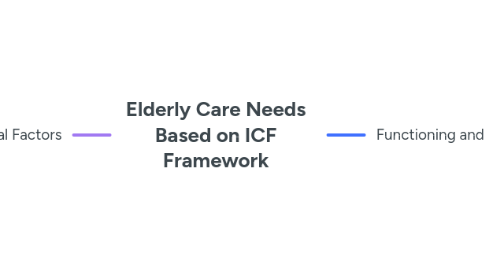
1. Contextual Factors
1.1. Environment Needs
1.1.1. Needs for daily objects
1.1.2. Needs for relatives and health personnel
1.1.3. Needs for health service provision
1.2. Personal Factors Needs
2. Functioning and Disability
2.1. Activities & Participation
2.1.1. Knowledge acquisition and application needs
2.1.1.1. d175 Solving problems
2.1.2. Traveling and social needs
2.1.2.1. d350 Conversation
2.1.2.2. d920 Recreation and leisure
2.1.2.3. d4 Mobility
2.1.3. Home Care Needs
2.1.3.1. d510 Washing oneself (bathing, drying, washing hands, etc)
2.1.3.2. d520 Caring for body parts (brushing teeth, shaving, grooming, etc.)
2.1.3.3. d530 Toileting
2.1.3.4. d540 Dressing
2.1.3.5. d550 Eating
2.1.3.6. d570 Looking after one’s health
2.1.3.7. d620 Acquisition of goods and services (shopping, etc.)
2.1.3.8. d630 Preparation of meals (cooking, etc.)
2.1.3.9. d640 Doing housework (cleaning house, washing dishes, laundry, ironing, etc.)
2.2. Body Functions
2.2.1. Mental Function Needs
2.2.1.1. b134 sleep
2.2.1.2. b 12 Emotional functions
2.2.1.3. b156 Perceptual functions
2.2.2. Physical Function Needs
2.2.2.1. b230 Hearing
2.2.2.2. b235 Vestibular (including balance functions)
2.2.2.3. b280 Pain
2.2.2.4. b410 Heart
2.2.2.5. b420 Blood pressure
2.2.2.6. b440 Respiration
2.2.2.7. b151 Digestive system
2.2.2.8. b525 Defecation
2.2.2.9. b555 Endocrine glands
2.2.2.10. b620 Urination functions
2.2.2.11. b7 Neuromusculoskeletal and movement-related functions
2.2.2.12. b8 Functions of the skin and related structures