


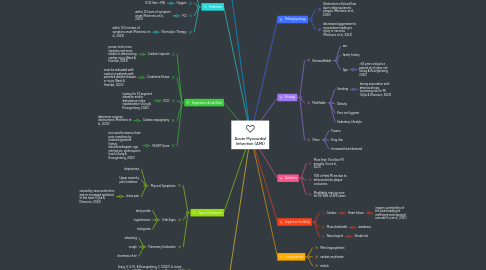
1. Referrals
1.1. Cardiologist
1.2. Cardiac Rehabilitation
1.2.1. has been shown to reduce future MI risk factors, improve quality of life, and decrease mortality rates (Mechanic et al., 2023)
1.3. Specialists (based on underlying conditions)
1.3.1. Endocrinologist
1.3.2. Nephrologist
1.3.3. Psychologist
2. Treatment
2.1. Medications
2.1.1. Aspirin/Antiplatelet
2.1.1.1. dose patient with 162mg-325mg initially (Mechanic et al., 2023)
2.1.2. Opioids PRN for pain
2.2. Oxygen
2.2.1. If O2 Sats <91%
2.3. PCI
2.3.1. within 12 hours of symptom onset (Mechanic et al., 2023)
2.4. Fibrinolytic Therapy
2.4.1. within 120 minutes of symptom onset (Mechanic et al., 2023)
3. Diagnostics & Lab Work
3.1. Cardiac troponin
3.1.1. proven to be more sensitive and more reliable in determining cardiac injury (Basit & Huecker, 2023)
3.2. Creatinine Kinase
3.2.1. must be evaluated with caution in patients with potential skeletal disease or injury (Basit & Huecker, 2023)
3.3. ECG
3.3.1. looking for ST segment elevation and/or disturbance in the repolarization (Aung & Roongsritong, 2022)
3.4. Cardiac angiography
3.4.1. determine coronary obstructions (Mechanic et al., 2023)
3.5. HEART Score
3.5.1. tool used to assess chest pain complains by evaluating patient history, electrocardiogram, age, risk factors, and troponin levels (Aung & Roongsritong, 2022)
4. Signs & Symptoms
4.1. Physical Symptoms
4.1.1. diaphoresis
4.1.2. Upper exremity pain/coldness
4.1.3. chest pain
4.1.3.1. caused by vasoconstriction and an increased workload of the heart (Ojha & Dhamoon, 2023)
4.2. Vital Signs
4.2.1. tachycardia
4.2.2. hypertension
4.2.3. tachypnea
4.3. Pulmonary Evaluation
4.3.1. wheezing
4.3.2. cough
4.3.3. shortness of air
5. References
5.1. Aung, S. S. M., & Roongsritong, C. (2022). A closer look at the HEART score. Cardiology Research, 13(5), 255–263. https://doi.org/10.14740/cr1432
5.2. Basit, H., & Huecker, M. R. (2023, August 14). Myocardial infarction serum markers. StatPearls - NCBI Bookshelf. https://www.ncbi.nlm.nih.gov/books/NBK532966/
5.3. Liu, H., Soares, J. S., Walmsley, J., Li, D. S., Raut, S., Avazmohammadi, R., Iaizzo, P., Palmer, M., Gorman, J. H., Gorman, R. C., & Sacks, M. S. (2021). The impact of myocardial compressibility on organ-level simulations of the normal and infarcted heart. Scientific Reports, 11(1). https://doi.org/10.1038/s41598-021-92810-y
5.4. Mechanic, O. J., Gavin, M., & Grossman, S. A. (2023, September 3). Acute myocardial infarction. StatPearls - NCBI Bookshelf. https://www.ncbi.nlm.nih.gov/books/NBK459269/
5.5. Ojha, N., & Dhamoon, A. S. (2023, August 8). Myocardial infarction. StatPearls - NCBI Bookshelf. https://www.ncbi.nlm.nih.gov/books/NBK537076/
6. Pathophysiology
6.1. Obstruction of blood flow due to atherosclerotic plaques (Mechanic et al., 2023)
6.2. decreased oxygenation to myocardium leading to injury or necrosis (Mechanic et al., 2023)
7. Etiology
7.1. Nonmodifiable
7.1.1. sex
7.1.2. family history
7.1.3. Age
7.1.3.1. >65 years old puts a patient at a higher risk (Aung & Roongsritong, 2022)
7.2. Modifiable
7.2.1. Smoking
7.2.1.1. strong association with atherosclerosis, increasing risk for MI (Ojha & Dhamoon, 2023)
7.2.2. Obesity
7.2.3. Poor oral hygiene
7.2.4. Sedentary Lifestyle
7.3. Other
7.3.1. Trauma
7.3.2. Drug Use
7.3.3. Increased heart demand
8. Statistics
8.1. More than 1.5 million MI annually (Liu et al., 2021)
8.2. 70% of fatal MI are due to atherosclerotic plaque occlusions
8.3. Modifiable risks account for 90-94% of AMI cases
9. Impact on the Body
9.1. Cardiac
9.1.1. Heart failure
9.1.1.1. impairs contractility of the heart leading to inefficient and impaired remodel (Liu et al., 2021)
9.2. Musculoskeletal
9.2.1. weakness
9.3. Neurological
9.3.1. Stroke risk