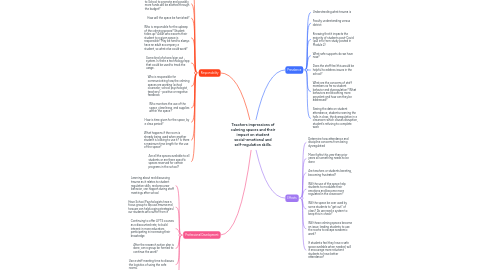
Teachers impressions of calming spaces and their impact on student social-emotional and self-regulation skills.par Colleen Thomas
1. Responsibility
1.1. Who will provide the resources? How is it financed? Could we have a Go Fund Me or look for donations from the community?
1.2. Showcase the spaces during Back to School to promote and possibly more funds will be allotted through the budget?
1.3. How will the space be furnished?
1.4. Who is responsible for the upkeep of the calming spaces? Student tidies up? Adult who escorts their student to a given space is responsible? May be hard to always have an adult accompany a student, so what else could work?
1.5. Some kind of phone/sign out system. Is there a technology/app that could be used to track the usage.
1.6. Who is responsible for communicating how the calming spaces are working (school counselor, school psychologist, teachers) - positive or negative feedback
1.7. Who monitors the use of the space, cleanliness, and supplies within the space?
1.8. How is time given for the space, by a class period?
1.9. What happens if the room is already being used when another student is looking to use it? Is there a maximum time length for the use of the space?
1.10. Are all the spaces available to all students or are there specific spaces reserved for certain programs in the school?
2. Professional Development
2.1. Learning about and discussing trauma as it relates to student regulation skills, and precursor behavior, can happen during staff meetings after school
2.2. Have School Psychologists have a focus group to discuss trauma and how we can help(coping strategies) our students who suffer from it
2.3. Continuing to offer LIFTS courses as a discounted rate, to build interest in more educators participating in increasing their knowledge
2.4. After the research action plan is done, can a group be formed to continue the work?
2.5. Use a staff meeting time to discuss the logistics of using the safe rooms.
2.6. The district needs to find value in the work to cover a stipend, so that each school in the district has strategies and calming safe places for all students
3. Prevalence
3.1. Understanding what trauma is
3.2. Faculty understanding versus district
3.3. Knowing that it impacts the majority of students post-Covid (pull info from study posted in Module 2)
3.4. What safe supports do we have now?
3.5. Does the staff feel this would be helpful to address issues in the school?
3.6. What are the concerns of staff members as far as student behavior and dysregulation? What behaviors are becoming more prevalent and how can they be addressed?
3.7. Seeing the data on student attendance, students roaming the halls in class, the dysregulation in a classroom which causes disruption, student’s refusing to complete work
4. Effects
4.1. Determine how attendance and discipline concerns from being dysregulated
4.2. More fights this year than prior years so something needs to be done
4.3. Are teachers or students berating, becoming frustrated?
4.4. Will the use of the space help students to modulate their emotions and become more regulated in the classroom?
4.5. Will the space be over used by some students to “get out” of class? Do we need a system to keep this in check?
4.6. Will these calming spaces become an issue, leading students to use the rooms to escape academic work?
4.7. If students feel they have a safe space available when needed, will it encourage more reluctant students to have better attendance?