
Teaching Nurses the Application of Abdominal Pressure in Colonoscopy

Teaching Nurses the application of abdominal pressure during colonoscopies

Teaching Nurses the Application of Abdominal Pressure in Colonoscopy
par Melissa Montefiore
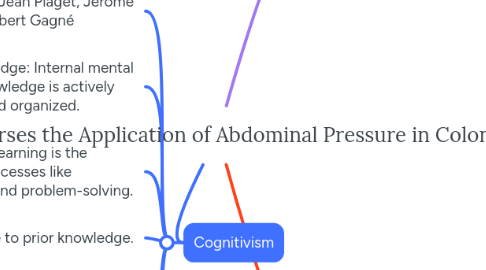
1. Cognitivism
1.1. Theorists: Jean Piaget, Jerome Bruner, Robert Gagné
1.2. View of Knowledge: Internal mental structures; knowledge is actively constructed and organized.
1.3. View of Learning: Learning is the result of mental processes like memory, thinking, and problem-solving.
1.4. Role of the student: Active processor of information; organizes and connects new knowledge to prior knowledge.
1.5. Role of the educator: Facilitator who structures content logically, provides guided discovery, and supports mental modeling.
1.6. Instructional application: Use visual aids, step-by-step demonstrations, and decision trees to scaffold understanding. Encourage nurses to articulate their reasoning during practice.
1.6.1. Scenario example: Instructor explains the why behind pressure points (assists in maneuvering the scope).
2. Behaviorism
2.1. Theorists: B.F. Skinner, Ivan Pavlov, John Watson
2.2. View of Knowledge: Observable behavior is a response to external stimuli. Knowledge is acquired through conditioning.
2.3. View of Learning: Learning occurs through repitition, re-inforcement, and feedback.
2.4. Role of Student: Passive recipient; responds to stimuli and reinforcement.
2.5. Role of Educator: Instructor provides stimulus-response training, reinforces correct behavior, corrects errors.
2.6. Instructional application: Repetition of correct pressure technique with immediate feedback until behavior is internalized.
2.6.1. Scenario Example: Use a simulation model where correct hand placement and pressure elicit positive feedback (e.g., lights or scores).
3. Constructivism
3.1. Theorists: Lev Vygotsky, Jean Piaget, John Dewey
3.2. View of Knowledge: Socially and individually constructed through experience.
3.3. View of Learning: Learning is an active, contextualized process of meaning-making.
3.4. Role of the Student: Active participant who constructs knowledge through experience and reflection.
3.5. Role of the Educator: Coach or guide who provides authentic tasks and facilitates social interaction.
3.6. Instructional Application: Use of peer collaboration to discuss different techniques and outcomes.
3.6.1. Scenario Example: Role-playing or real-time practice in clinical settings.
4. Humanism
4.1. Theorists: Carl Rogers, Abraham Maslow
4.2. View of Knowledge: Self-directed and personally meaningful.
4.3. View of Learning: Learning is driven by intrinsic motivation, self-actualization, and relevance.
4.4. Role of the Student: Centered in the learning process; responsible and self-motivated.
4.5. Role of the Educator: Supporter and enabler of a safe, respectful learning environment.
4.6. Instructional Application: Foster a supportive environment where questions are welcomed and personal growth is emphasized.
4.6.1. Scenario Example: Provide reflective journaling or debriefs post-practice to explore feelings and confidence.