


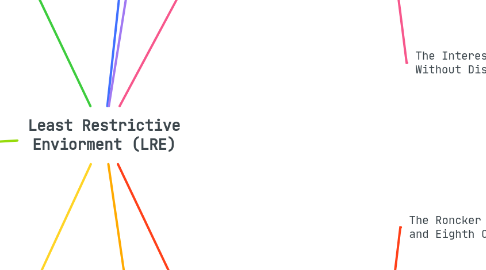
1. Lessons from Litigation and Legislation
1.1. Principle 1: The primary objective when developing a student’s special education program is appropriateness.
1.2. Principle 2: Place students in settings in which they have the most contact with their nondisabled peers.
1.3. Principle 3: Use the continuum of placements to determine the least restrictive appropriate placement.
2. A Model for Determining LRE
2.1. Step 1: The team determines that a student is eligible for services.
2.2. Step 2: The team defines what constitutes appropriate educational services for the student.
2.3. Step 3: The team asks whether these appropriate educational services can be delivered in the general education classroom in its current form. If the answer is yes, then the general education setting becomes the student’s primary placement. If it is no, go to Step 4.
2.4. Step 4: The team asks whether these appropriate educational services can be delivered in the general education classroom if the setting is modified through the addition of supplementary aids and services. If yes, then the general education setting with supplementary aids and services becomes the student’s primary placement. If no, go to Step 5.
2.5. Step 5: If the team determines that the general setting, even with supplementary aids and services, is not appropriate, the team should determine placement by moving along the continuum of alternative placements one step at a time, from the least restrictive setting to more restrictive ones. At each step, ask whether the services called for in the IEP can be delivered in that setting. If yes, then the setting becomes the student’s primary placement. If no, go to Step 6.
2.6. Step 6: The team asks whether the services called for in the IEP can be delivered in the slightly more restrictive settings if they are modified through the use of supplementary aids and services. If yes, that is the primary placement; if no, repeat Step 5 for a placement on the continuum that is slightly more restrictive, and then, if necessary, go to Step 6 for that setting. (In this manner, the placement team moves along the continuum of alternative placements, one step at a time, repeating Steps 5 and 6 until a yes answer is obtained.)
2.7. Step 7: In the context of the primary placement chosen, ask if there are additional opportunities for integration for some portion of the student’s school day. If yes, design a split placement by including the student in the integrated setting for part of the school day and in the more restrictive setting for part of the school day.
3. Personal connection
3.1. I worked as a paraprofessional. I worked with a boy with autism in the 3rd grade. He was super smart but lacked social skills and struggled with large changes. I honeslty feel that paras are super useful but the problem is that they do not recieve the appropriate training to make a difference. I was 18 and literally had no training to prepare me to handle the task I was given. Especially when they are being contracted from a company like Journeys DDA and HAAS (companies in idaho falls).
4. The end of segregation of disabled students piggy backed off the end of segregation of colored students.
5. LRE, Mainstreaming, and Inclusion
5.1. Inclusion, or full inclusion, is a general philosophical stance that sometimes is adopted by schools as practice. It is simply the idea that all students with disabilities will spend the majority or all of their time in the general educational environment.
5.2. Mainstreaming is a somewhat dated term that also refers to a philosophy of educating students with disabilities in settings with nondisabled students.
5.3. Least restrictive environment refers to the mandate within the Individuals with Disabilities Education Act (IDEA) that students with disabilities should be educated to the maximum extent appropriate with their peers who do not have disabilities.
5.4. Champagne (1993) defined restrictiveness as “a gauge of the degree of opportunity a person has for proximity to, and communication with, the ordinary flow of persons in our society” (p. 5).
5.5. The LRE Mandate
5.5.1. The IDEA requires that, when appropriate, students with disabilities be educated in settings with children without disabilities.
5.5.2. Schools must make good-faith efforts to place and maintain students in less restrictive settings.
5.5.2.1. also requires that before students with disabilities are placed in more restrictive settings, efforts must first be made to maintain a student in less restrictive settings with the use of supplementary aids and services. It is only when an appropriate education cannot be provided, even with supplementary aids and services, that students with disabilities may be placed in more restrictive settings.
5.5.3. further requires that state education agencies ensure that the LRE requirement extends to students in public schools, private schools, and other care facilities.
5.6. Continuum of Alternative Placements
5.6.1. Regulations require that
5.6.1.1. Each [school district] shall ensure that a continuum of alternative placements is available to meet the needs of children with disabilities for special education and related services
5.6.1.2. The continuum required … must:
5.6.1.2.1. Include the alternative placements … (instruction in regular classes, special classes, special schools, home instruction, and instruction in hospitals and institutions);
5.6.1.2.2. Make provision for supplementary services (such as resource room or itinerant instruction) to be provided in conjunction with regular class placement.
5.6.2. The IEP team determines the placement along this continuum that is the least restrictive setting in which a student will receive an appropriate education.
6. Considerations in Educational Placements
6.1. Determining a Student’s Placement
6.1.1. A team of qualified individuals and a student’s parents and other persons who are knowledgeable about a student, the meaning of the evaluation data, and the placement options is the group that determines a student’s placement (IDEA Regulations, 34 C.F.R. § 300.116[a][1]). Although this team is often also a student’s IEP team, it does not need to be (Bateman, 2017) as long as the IEP team is properly constituted (IDEA Regulations, Appendix A to Part 300, Notice of Interpretation, Question No. 37, 1999).
6.1.2. First, placement decisions should not be based solely on factors that are unrelated to a student’s actual needs.
6.1.3. a student’s placement must not be predetermined.
6.1.4. an IEP team should not determine a student’s placement prior to developing his or her IEP.
6.2. Placement in the Neighborhood School
6.2.1. Unless the IEP requires otherwise, students with disabilities should be educated in the school they would attend if they were not in special education (IDEA Regulations, 34 C.F.R. § 300.116(b)(3)). Moreover, the IDEA requires that if special education students cannot be placed in the neighborhood school, they must be placed as close to home as possible (IDEA Regulations, 34 C.F.R. § 300.116(b)(3)).
6.3. Nonacademic Programming
6.3.1. Regulations implementing the IDEA extend the LRE requirements to areas such as extracurricular services, meals, recess periods, counseling services, athletics, transportation, health services, recreational activities, and special interest groups or clubs sponsored by the school (IDEA Regulations, 34 C.F.R. § 300.306(a)).
6.4. The Interests of Peers Without Disabilities
6.4.1. where a [student with disabilities] is so disruptive in a regular classroom that the education of other students is significantly impaired, the needs of the [student with disabilities] cannot be met in that environment. Therefore regular placement would not be appropriate to his or her needs. (Section 504 Regulations, 34 C.F.R. § 104 Appendix A, Paragraph 24)
6.4.2. [I]f a child with a disability has behavioral problems that are so disruptive in a regular classroom that the education of other children is significantly impaired, the needs of the child with a disability generally cannot be met in that environment. However, before making such a determination, LEAs must ensure that consideration has been given to the full range of supplementary aids and services that could be provided to the child in the regular educational environment to accommodate the unique needs of the child with a disability. (Fed. Reg., Comments to 34 C.F.R. § 300.116 at 46,589)
7. Judicial Standards of Review
7.1. The Roncker Test (Sixth and Eighth Circuits)
7.1.1. the act (PL 94-142) does not require mainstreaming in every case but its requirement that mainstreaming be provided to the maximum extent appropriate indicates a very strong congressional preference.(p. 1063)
7.1.2. In a case where the segregated facility is considered superior, the court should determine whether the services which make that placement superior could feasibly be provided in a nonsegregated setting. If they can, the placement in the segregated school would be inappropriate under the Act. (Roncker, p. 1063)
7.1.3. 1. Can the educational services that make a segregated placement superior be feasibly provided in an unsegregated setting? 2. If so, the placement in the segregated setting is inappropriate.
7.2. The Daniel Test (Second, Third, Fifth, Tenth, and Eleventh Circuits)
7.2.1. 1. Can education in the general education classroom with supplementary aids and services be achieved satisfactorily? 2. If a student is placed in a more restrictive setting, is the student integrated to the maximum extent appropriate?
7.2.2. In addition to the test, the Daniel court provided further direction for lower courts to follow in LRE cases in noting that the court’s “task is not to second-guess state and local school officials; rather, it is the narrow one of determining whether state and local school officials have complied with the Act” (p. 1048).
7.3. The Rachel H. Test (Ninth Circuit)
7.3.1. 1. The educational benefits of the general education classroom with supplementary aids and services as compared with the educational benefits of the special classroom 2. The nonacademic benefits of interaction with students without disabilities 3. The effect of the student’s presence on the teacher and on other students in the classroom 4. The cost of mainstreaming
7.4. The DeVries Test (Fourth Circuit)
7.4.1. 1. A student with a disability would not receive educational benefit from mainstreaming in a general education class. 2. Any marginal benefit from mainstreaming would be significantly outweighed by benefits that could feasibly be obtained only in a separate instructional setting. 3. The student is a disruptive force in the general education classroom.
8. Factors in Determining the LRE
8.1. Individualization
8.1.1. The decisions in Greer v. Rome City School District (1991) and Oberti v. Board of Education (1993) are particularly instructive, as the courts delineated the inappropriate actions by the school districts that resulted in the districts’ losses in these cases.
8.1.1.1. In Greer, the court ruled against the school district because (a) the IEP team failed to consider the full continuum of placements in determining the LRE; (b) the school made no attempt to assist the student to remain in the mainstream setting; and (c) the school district developed the IEP prior to the IEP meeting and did not clearly inform the Greers of the full range of services that may have been required to maintain their child in the general education classroom.
8.1.2. The IDEA, its regulations, and comments to these regulations make it clear that the IEP team can only make this decision by examining students’ needs and determining their goals based on this assessment.
8.1.3. Federal regulations require that “the overriding rule … is that placement decisions must be made on an individual basis” (IDEA Regulations, 34 C.F.R. § 300.552, comment).
8.1.4. In 1991, OSERS interpreted the LRE mandate as requiring that “children with disabilities should be educated with nondisabled children to the maximum extent appropriate; however, the determination of whether to place a child with disabilities in an integrated setting must be made on a case-by-case basis” (Letter to Stutler and McCoy, 1991, p. 308).
8.2. Benefits to the Student
8.2.1. the school may compare the educational benefits of the general education classroom (with supplementary aids and services) with those received in the special education classroom. This comparison should include both academic and nonacademic (e.g., language, role-modeling) activities.
8.3. Effect on Peers
8.3.1. School personnel may consider the effect the presence of a student with disabilities in a general education classroom would have on the education of other students in that classroom...In weighing this factor, however, the school is cautioned by both the Oberti and Greer courts of their obligation to first consider the use of supplementary aids and services to accommodate a student.
8.4. Appropriateness
8.4.1. Legislation and litigation regarding LRE and FAPE indicate that the school’s primary obligation is to provide the student with disabilities with a FAPE. The LRE principle, although important, is secondary (Bateman & Linden, 2012; Champagne, 1993).
8.5. Integration
8.5.1. An appropriate interpretation of the LRE cases is that students with disabilities belong in integrated settings and that schools must make good-faith efforts to make this possible.
8.5.2. The IDEA clearly requires the maximum amount of integration that is appropriate given a student’s needs.
8.6. The Use of Supplementary Aids and Services
8.6.1. A key to meeting the LRE mandate is a school’s proper use of supplementary aids and services. School districts must make good-faith efforts to maintain students in a general education class placement, and the provision of various supplementary aids and services is a means by which schools can maintain students with disabilities in these settings.
8.6.2. Supplementary aids and services may include assistive technology services or devices, prereferral interventions, consultation, behavior management plans, paraprofessionals, itinerant teachers, and resource rooms.
8.6.3. The schools need to show that they considered all their options and provided what they could.