


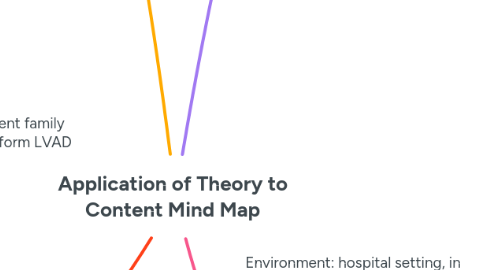
1. Topic: teaching patient family member how to perform LVAD dressing change
2. Learners: support person of LVAD patient
3. Environment: hospital setting, in room with patient or with manikin
4. Experiential Learning Theory
4.1. Theorist
4.1.1. David Kolb
4.2. View of Knowledge
4.2.1. New knowledge is created through experience
4.2.2. Knowledge is co-created
4.3. View of Learning
4.3.1. Learning is through active construction
4.3.2. It is an active, cyclical process of engaging in experience, observing and reflecting on it, forming concepts through reflection, and applying new ideas through real world application
4.4. Role of Student
4.4.1. Learner is active participant in co-creating knowledge.
4.4.2. Learner must go through the cyclical process to
4.5. Role of Educator
4.5.1. Acts as a facilitator for new experience, support learner in connecting experience to theory
4.5.2. Support learner in stages of this theory
4.6. How Theory Informs Instruction in this Scenario
4.6.1. Educator will create manikin for learner to practice LVAD dressing on
4.6.1.1. Educator will support learner through reflection process on what went well
4.6.1.1.1. Educator will then help learner connect experience to care of LVAD and infection prevention concepts
5. Social Learning Theory
5.1. Theorist
5.1.1. Albert Bandura
5.2. View of Knowledge
5.2.1. knowledge is constructed and aquired through observation, imitation and modeling
5.3. View of Learning
5.3.1. learning occurs through observational learning and reinforcement.
5.3.2. The four key processes to learning are attention, retention, reproduction, and motivation
5.4. Role of Student
5.4.1. learners are an active participant
5.4.2. learners are to observe role-models, analyze behavior, and decide to how replicate it
5.5. Role of Educator
5.5.1. Acts as the facilitator and role model
5.5.2. Provides feedback
5.5.3. fosters a supportive environment
5.6. How this Theory Informs Instruction of this Scenario
5.6.1. Educator will provide a demonstration of LVAD dressing change while explaining each step outloud
5.6.2. Educator will then observe the family member change the LVAD dressing
5.6.2.1. LVAD dressing can be done on manikin initially to foster a more supportive safe environment
5.6.3. Educator will give direct feedback
6. Andragogy
6.1. Theorist
6.1.1. Malcom Knowles
6.2. View of Knowledge
6.2.1. Knowledge is experiental, problem-centered and built on prior experiences
6.2.2. Knowledge is considered meaningful when it is immediatley applicable to real life
6.2.3. Knowledge is co-constructed through discussion, reflection and application
6.3. View of Learning
6.3.1. Learning is self-directed and immediate to real-world problems
6.3.2. Leanring is collaborative, active, and continuous
6.4. Role of Student
6.4.1. Learners are active participants
6.4.2. Learners are to draw on past experiences and knowledge
6.4.3. Learners are expected to critically engage and apply information to practical situations
6.5. Role of Educator
6.5.1. Acts as a facilitator
6.5.2. Teaching focuses on real-world application, problem-solving and relevance
6.6. How the Theory Informs Instruction
6.6.1. Explain the "why" - importance of proper dressing change technique
6.6.2. Enable safe direction; offer a variety of learning resources, allowing the to select which resources to use
6.6.3. Allow them to share past experiences: any experiences with dressing changes, infection, any previous learning on LVAD
6.6.4. Emphasis clinical relevance; explain that the learner will be doing the dressing change weekly at home
6.6.5. Orientatin to learning; asking questions that engage them in growing their practical knowledge- what would you do if the dressing was coming up? How do you maintain a sterile field?
6.6.6. Reinforce the importance of mastering the skil
7. Behaviorism
7.1. Theorists
7.1.1. Skinner, Pavlov, Watson
7.2. View of Knowledge
7.2.1. New behaviors are created through conditioning
7.2.2. Knowledge is objective
7.2.3. Knowledge can be measured by performance outcomes
7.3. View of Learning
7.3.1. Behavior modification occurs through reinforcement and repetition
7.4. Role of Student
7.4.1. Learner is a reactive participant, responding to feedback and practicing desired behavior
7.5. Role of Educator
7.5.1. Educator creates and control the learning environment
7.5.2. Provides reinforcement
7.6. How the Theory Informs Instructed
7.6.1. Educator provides step by step instructions for LVAD dressing change
7.6.2. Provides opportunity for repetitive practice of dressing change on manikin
7.6.3. Offers direct feedback