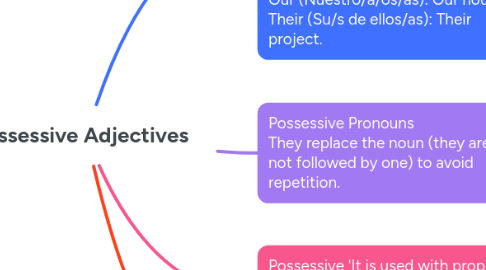
1. It is placed before the noun to modify it and indicate to whom it belongs.My (Mi/s): My car. Your (Tu/s, Su/s de usted): Your name. His (Su/s de él): His ball. Her (Su/s de ella): Her job. Its (Su/s de animal o cosa): Its color. Our (Nuestro/a/os/as): Our house. Their (Su/s de ellos/as): Their project.
1.1. My car. Your (Tu/s, Su/s de usted): Your name. His (Su/s de él): His ball. Her (Su/s de ella): Her job. Its (Su/s de animal o cosa): Its color. Our (Nuestro/a/os/as): Our house. Their (Su/s de ellos/as): Their project.
2. Possessive Pronouns They replace the noun (they are not followed by one) to avoid repetition.
2.1. Mine (Mío/a/os/as): This is mine. Yours (Tuyo/s, Suyo/s): Is this yours?. His (Suyo de él): The car is his. Hers (Suyo de ella): The house is hers. Ours (Nuestro/a/os/as): The victory is ours. Theirs (Suyo de ellos/as): Theirs is better.
3. Possessive 'It is used with proper names or common nouns to indicate a relationship of belonging or kinship.
3.1. Singular: Se añade 's. Ej: John's car (El carro de John). Plural (termina en -s): Solo se añade el apóstrofe ('). Ej: Parents' house. Plural irregular: Se añade 's. Ej: Children's toys.
4. Possessive Nouns)They function similarly to the Saxon genitive but are classified according to their nature.
4.1. Singulares: Javier's car. Plurales: The students' last day. Irregulares: The women's clothes.