

1. REVISIONISM
1.1. Diminuition of race as a conflict. As Brazil became a more fully capitalist society it was less characterized by the residues of slavery.
2. ESCAPE HATCH
2.1. Distinguished mulattoes from blacks, it was social mobility (lighter blacks). It was whitening as a solution of Brazil's racial problems as well as economic mobility and integration into class society.
2.2. Racial inequality persistent. It was observed in levels of income, employment, access to education, health care, and housing. After 100 years of the end of slavery, blacks were concentrated in the bottom strata. Race was still a crucial determinant of economic success.
3. STRUCTURALIST VIEW
3.1. Expects the elite's smooth maintenance of racial equality to be no where more efficiently carried out than under the military dictatorship.
3.1.1. Project specifications
3.1.2. End User requirements
3.1.3. Action points sign-off
4. BLACK SOUL
4.1. It was a movement over states by youth which identified the interests of blacks in Brazil, the interests of blacks elsewhere, and addressed the issues of racial identity. It grew consideration from everywhere, even the military.
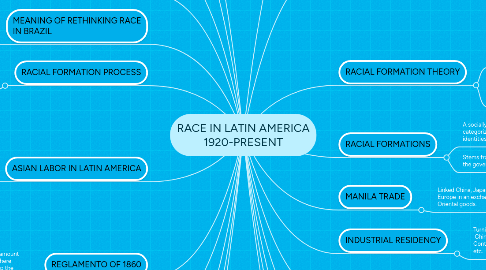
5. MEANING OF RETHINKING RACE IN BRAZIL
5.1. Thinking about racial formation as a process of permanently contested social institutions and permanently conflictual identities.
6. RACIAL FORMATION PROCESS
6.1. States that for democracy to truly take hold, "the racial dimensions of Brazilian life will be questioned and examined by those who must live them out."
7. ASIAN LABOR IN LATIN AMERICA
7.1. After Mexico's and Peru's independence from Spain and the cessation of the Manila Trade international labor migration began with massive waves from China, later joined by the Japanese. Japanese immigrants mostly went to Brazil.
7.2. Peru and Cuba promoted importation of coolies or contract laborers to work on sugar plantations. Known as the yellow trade.
7.2.1. Asians went through economic exploitation, racist discrimination, and cultural suppression.
7.3. Yellow Trade
7.3.1. resemblance to African Slave Trade. 250,000 coolies for 8 year contracts were sent to Cuba and Peru.
7.4. Labor of the Asians in Latin America have not been adequately recognized and fully documented.
7.4.1. Prosperity of Mexico and Peru could not have happened without the sweat of the Chinese
8. REGLAMENTO OF 1860
8.1. obligated coolies to work in a contract for an unspecified amount of time or to leave Cuba. This system resembled slavery. There was no distinction in between the two. Racism helped keep the Chinese captive.
9. WAR OF PACIFIC
9.1. Chilean army invaded and liberated the coolies, they then began wage labor (or the enganche sytem)
10. CHINESE EXCLUSION ACT OF 1882
10.1. Chinese became the first group designated by race barred from entering the country
10.2. The Chinese were also expelled from Mexico and fled to Baja California and some also returned to China
11. CIMARRON MOVEMENT
11.1. It was the development of Black culture. Columbia never had a mass impact of people understanding black culture
11.1.1. Symbols of resistance to oppression and continuity of African traditions. Literal meaning is something domesticated which was applied to runaway slaves
12. LAW 70
12.1. Recognizes black communities as an ethnic group and gives rights to the whole black community
12.1.1. They are no longer invisible as they once were. But blackness is still not mainstream in Columbia as it is in Jamaica or Haiti
13. "FARCE OF ABOLITION"
13.1. May 13th was the 100th anniversary of the abolition of slavery in Brazil but it was not universal.
13.2. Many groups organized to draw attention to the racial inequality and discrimination still present.
13.2.1. "100 Years of Lies"
13.2.1.1. "100 Years Without Abolition"
14. UNESCO STUDIES
14.1. Effective theory in dismantling the myth of a non-racist national culture.
14.1.1. Materials
14.1.2. Personel
14.1.3. Services
14.1.4. Duration
14.2. UNESCO Researchers
14.2.1. Thales de Azevedo
14.2.2. Roger Bastide
14.2.3. Marvin Harris
14.2.3.1. Suggested that Brazilian system of racial identification subordinated race to class.
14.2.4. Florestan Fernandes
14.2.4.1. Thought Brazil's racial dilemma is a result of survivals from days of slavery which came into conflict with capitalist development. To him race is a problem whose solution is integration.
14.2.4.2. Recognized the continuing presence and significance of race that others tended to dismiss.
15. RACIAL FORMATION THEORY
15.1. Responds to both ongoing racial inequalities and to the persistance of racial difference
15.1.1. Dependencies
15.1.2. Milestones
15.2. Developed as a response to reductionism. This perspective understands race as a phenomenon whose meaning is contested throughout social life.
16. RACIAL FORMATIONS
16.1. A socially and historically construct which categorizes people and places meanings and identities to people in a given society
16.2. Stems from elites, institutions, the government, religion
17. MANILA TRADE
17.1. Linked China, Japan, and the Philippines to Europe in an exchange of Mexican silver for Oriental goods.
18. INDUSTRIAL RESIDENCY
18.1. Turning from China to India for labor. Contracts in Trinidad, France, Britain, etc.
19. ENGANCHADOR SYSTEM
19.1. In Peru the Enganchador who had been a coolie himself in the past negotiated terms of the squad. He was an independent merchant of trading of goods and people but was responsible for any damages.
20. CHINESE PRODUCTION
20.1. By the 20th century, the Chinese controlled the trade in groceries, dry goods, and general merchandise
21. COLUMBIA
21.1. Columbia had the largest black population in Latin America. Concentartion in poor and underdeveloped areas
22. CONSTITUTION REFORM
22.1. After the Constitution of Columbia had been changed they still denied Blacks any status as an ethnic group. They defined them as peasants but not an ethnic group.
22.1.1. Blacks have given but not received. They helped build the nation through slavery but have still been objects of discrimination.