


1. People
1.1. Paul Broca
1.1.1. Discovered that damage to the frontal lobe causes difficulty in speech but not language comprehension
1.2. Charles Darwin
1.2.1. Functionalism was strongly influenced by his THEORY OF EVOLUTION and his emphasis on NATURAL SELECTION
1.3. Michael Gazzaniga
1.3.1. Studies the split-brain (use of two different hemispheres) and how people act
1.4. Roger Sperry
1.4.1. Began the split-brain experiments which Gazzaniga continued
1.5. Carl Wernicke
1.5.1. Damage to the temporal lobe does not effect speech and language, but it is does effect understanding and comprehension
2. Neural Structure and Behavior
2.1. Structure of the Brain
2.1.1. Forebrain
2.1.1.1. collection of upper level brain structures
2.1.1.1.1. thanlmus
2.1.1.1.2. hypothalamus
2.1.1.1.3. limbic system
2.1.1.1.4. cerebral cortex
2.1.2. Midbrain
2.1.2.1. collection of brain structures in the middle of the brain responsible for coordinating movement patterns, sleep, and arousal
2.1.3. Hindbrain
2.1.3.1. collection of brain structures in the bottom part of the brain
2.1.3.1.1. medulla
2.1.3.1.2. cerebellum
2.1.3.1.3. pons
2.2. Neuron
2.2.1. cell of the nervous system responsible for receiving and transmitting electrochemical information
2.2.1.1. dendrites
2.2.1.1.1. branching neuron structures that receive neural impulses from other neurons and convey impulses toward the cell body
2.2.1.2. cell body
2.2.1.2.1. part of the neuron containing the cell nucleus, as well as other structures that help the neuron carry out its functions; aka the soma
2.2.1.3. axon
2.2.1.3.1. long tube like structure that conveys impulses away from the neuron's cell body toward the other neurons or to muscles or glands
2.2.1.4. myelin sheath
2.2.1.4.1. layer of fatty insulation wrapped around the axon of some neurons, which increases the rate at which nerve impulses travel along the axon
3. Neurotransmitters
3.1. chemical messengers that traverse the synaptic gaps between neurons
3.1.1. when released by the sending neuron, neuro-transmitters travel across the synapse and bind to receptor sites on the receiving neuron, thereby influencing whether it will generate a neural impulse
3.2. Acetylcholine
3.2.1. a neurotransmitter that, among its functions, triggers muscle contraction; is involved in memory
3.3. Endorphins
3.3.1. natural, opiate like neurotransmitters linked to pain control and to pleasure
3.4. Dopamine
3.4.1. Involved in the control of bodily movements, learning, attention, & emotion
3.5. Serotonin
3.5.1. Affects mood, hunger, sleep and arousal
3.6. Gaba
3.6.1. inhibitory neurotransmitter; weakens or slows down signals
3.7. Norepinephrine
3.7.1. chemical released from the sympathetic nervous system in response to stress
4. The Central Nervous System
4.1. Brainstrem
4.1.1. houses parts of the fore-brain, mid-brain, and hind-brain, and helps regulate reflex activities critical for survival
4.2. Limbic System
4.2.1. interconnected group of fore-brain structures involved with emotions, drives, and memory
4.3. Cerebral Cortex
4.3.1. regulates most complex, behavior, including sensations, motor control, and higher mental processes
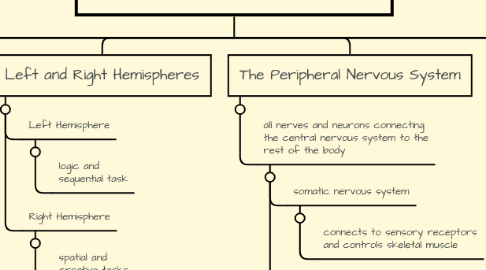
5. Left and Right Hemispheres
5.1. Left Hemisphere
5.1.1. logic and sequential task
5.2. Right Hemisphere
5.2.1. spatial and creative tasks
6. The Peripheral Nervous System
6.1. all nerves and neurons connecting the central nervous system to the rest of the body
6.1.1. somatic nervous system
6.1.1.1. connects to sensory receptors and controls skeletal muscle
6.1.2. autonomic nervous system
6.1.2.1. controls involuntary function, such as heart rate and digestion
6.1.2.1.1. sympathetic nervous system
6.1.2.1.2. parasympathetic nervous system
7. The Endocrine System
7.1. collection of glands located throughout the body that manufacture and secrete hormones into the bloodstream
7.1.1. hormones
7.1.1.1. chemical messengers that are secreted directly into the blood, which carries them to organs and tissues of the body to exert their functions
7.2. pineal gland
7.3. hypothalmus gland
7.4. pituitary gland
7.5. thyroid gland
7.6. parathyroid gland
7.7. adrenal gland
7.8. pancreas
7.9. ovaries
7.10. testes
8. Tools for Studying the Nervous System
8.1. brain dissection
8.1.1. careful cutting and study of a cadaver's brain to reveal structural details
8.2. ablation/lesions
8.2.1. surgically removing parts of the brain or destroying specific areas of the brain
8.3. observations/case studies
8.3.1. observing and recording changes in personality, behavior, or sensory capacity associated with brain disease or injuries
8.4. electrical recordings
8.4.1. using electrodes attached to the skin or scalp, brain activity is detected and recorded on an electroencephalogram
8.5. electrical stimulation of the brain
8.5.1. using an electrode, a weak electric current stimulates specific areas or structures of the brain
8.6. CT scan
8.6.1. computer-created cross sectional x-rays of the brain
8.7. PET scan
8.7.1. radioactive form of glucose is injected into the bloodstream and scanners record amount of glucose using in particularly active areas of the brain and produces computer-constructed picture of the brain
8.8. MRI scan
8.8.1. high frequency magnetic field is passed through the brain by means of electromagnets
8.9. fMRI scan
8.9.1. newer, faster version of the MRI that detects blood flow by picking up magnetic signals from blood that has given up its oxygen to activate brain cells
8.10. TMS
8.10.1. recent method of brain stimulation that delivers a large current through a wire coil placed on the skull
9. Genetics: Heredity and Environment
9.1. Heritability
9.1.1. measure of the degree to which a characteristic is related to genetic, inherited factors versus the environment
9.1.1.1. chromosomes
9.1.1.1.1. threadlike molecule of DNA that carries genetic information
9.1.1.2. genes
9.1.1.2.1. segments of DNA that occupies a specific place on a particular chromosome and carries the code for hereditary transmission
10. Evolutionary Psychology
10.1. studies how evolutionary processes, like natural selection and genetic mutations, affect behavior and mental processes
10.2. behavioral genetics
10.2.1. study of the relative effects of heredity and the environment on behavior and mental processes
10.3. natural selection
10.3.1. driving mechanism behind evolution that allows individuals with genetically influenced traits that are adaptive in a particular environment to stay alive and produce more offspring