

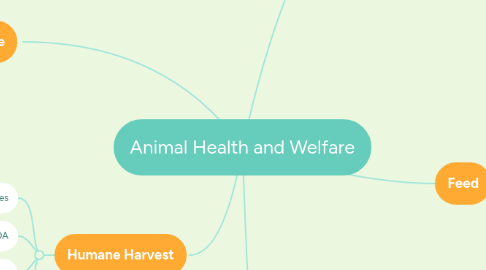
1. Ensuring Welfare
1.1. Veterinary care
1.2. Government legislations
1.2.1. Animal Welfare Act
1.2.2. Audits
1.2.2.1. Unbiased third party evaluation
1.3. Enrichment
1.3.1. Toys for animals
1.3.2. Balls and hoses for animals
1.4. Regulations
1.4.1. Biosecurity
1.4.2. Proper care of the animals
2. Humane Harvest
2.1. Guidelines
2.1.1. How to keep animals calm and healthy
2.2. USDA
2.3. Food Safety and Inspection Services
2.4. Constant veterinary medical supervision
3. Animal Housing
3.1. Stalls
3.1.1. Help farmer to control housing temperatures
3.1.1.1. Mothers are able to be in a cooler temperature while babies are warmer
3.1.2. Prevents babies from being harmed
3.1.3. Safety for farmer
3.1.3.1. When females are pregnant they are more aggressive
3.2. Open Barn
3.2.1. Animals have freedom to walk
3.2.2. Animals are able to graze on the pasture
3.2.3. Can be in the barn and leave whenever they want
3.2.4. Given bedding
3.2.4.1. Creates a more comfortable environment
3.3. Indoor Barn
3.3.1. Controlled temperatures
3.3.2. Easier to care for sick, calving, and weaning animals
3.3.3. Increased ventilation
3.3.3.1. Controlled environment
3.3.3.2. Better control on diseases
4. Feed
4.1. Alternative feeds
4.2. Additives
4.2.1. Vitamins and minerals
4.3. Fats
4.3.1. Supplements
4.3.1.1. Fish oil
4.4. High energy
4.4.1. Total mixed ration
4.5. Consistent diet
4.5.1. Forage
4.5.1.1. Such as grass
4.5.2. Roughage
4.5.2.1. Such as Hay
4.6. WATER
4.6.1. Animals always have access to water