


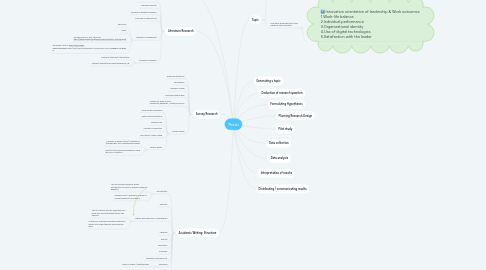
1. Academic Writing: Structure
1.1. Introduction
1.1.1. Use the inverted pyramid: Broad introduction to topic to specific research question
1.1.2. Research Gap / Relevance of topic in current research / in practice
1.2. Abstract
1.3. Theory and deduction of hypotheses
1.3.1. Cite all relevant articles; show that you know the most important articles and theories
1.3.2. At the end, postulate hypotheses that you derive from other theories and empirical work
1.4. Methods
1.5. Results
1.6. Discussion
1.7. Summary
1.8. Literature: Reference list
1.9. Appendix
1.9.1. Table of Figure / Questionnaire
1.10. Style
1.10.1. Logical Flow/ Orthography/Academic language / APA Style
1.10.2. APA Style:
2. Timeline
3. Literature Research
3.1. Types of publications
3.2. Literature sources
3.3. Process of literature research
3.4. overview of search tools
3.5. Literature Management
3.5.1. End Note
3.5.2. Citavi
3.5.3. For the basics of APA style see http://www.apastyle.org/learn/tutorials/basics-tutorial.aspx)
3.5.4. The impact factor: http://adminapps. webofknowledge.com/JCR/JCR?PointOfEntry=Home&SID=N1CcJ33@@1o7Gl8lj@ M
3.6. Academic Research
3.6.1. Heading/ Abstract/ introduction
3.6.2. Method/ Results/Discussion/Reference_list
4. Survey Research
4.1. Research Questions
4.2. Hypotheses
4.3. Research Model
4.4. Common method bias
4.5. Criteria for good Survey: Objectivity,Reliability, Validity,Economy
4.6. Survey Design
4.6.1. Close-ended Questions
4.6.2. Open-ended Questions
4.6.3. Rating Scale
4.6.4. Semantic Differential
4.6.5. Self-rating / Other-rating
4.6.6. Helpful Books
4.6.6.1. „X Buhner & Ziegler (2009). Statistik fur Psychologen und Sozialwissenschaftler
4.6.6.2. Field (2013). Discovering statistics using IBM SPSS Statistics
5. Data collection
6. Generating a topic
7. Deduction of research question
8. Formulating Hypotheses
9. Planning Research Design
10. Pilot study
11. Data analysis
12. Interpretation of results
13. Distributing / communicating results
14. Topic
14.1. How Can leader Empower their Employees?
14.2. How does leadership affect the creativity and innovation
14.2.1. Innovation orientation of leadership & Work outcomes 1.Work-life balance 2.Individual performance 3.Organizational identity 4.Use of digital technologies 5.Satisfaction with the leader