

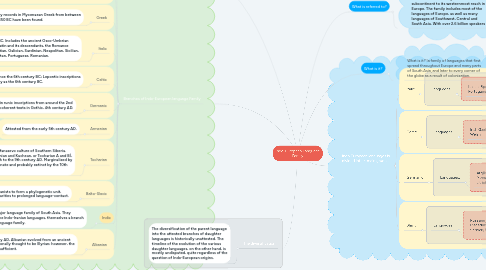
1. Branches of Indo-European language Family
1.1. Anatolian
1.1.1. Extinct by Late Antiquity, spoken in Asia Minor, attested in isolated terms in Luwian/Hittite mentioned in Semitic Old Assyrian texts from the 20th and 19th centuries BC, Hittite texts from about 1650 BC.
1.2. Indo-Iranian
1.2.1. Atested circa 1400 BC, descended from Proto-Indo-Iranian (dated to the late 3rd millennium BC).
1.3. Greek
1.3.1. Fragmentary records in Mycenaean Greek from between 1450 and 1350 BC have been found.
1.4. Italic
1.4.1. Attested from the 7th century BC. Includes the ancient Osco-Umbrian languages, Faliscan, as well as Latin and its descendants, the Romance languages, such as Italian, Venetian, Galician, Sardinian, Neapolitan, Sicilian, Spanish, French, Romansh, Occitan, Portuguese, Romanian.
1.5. Celtic
1.5.1. Attested since the 6th century BC; Lepontic inscriptions date as early as the 6th century BC.
1.6. Germanic
1.6.1. Earliest attestations in runic inscriptions from around the 2nd century AD, earliest coherent texts in Gothic, 4th century AD.
1.7. Armenian
1.7.1. Attested from the early 5th century AD.
1.8. Tocharian
1.8.1. With proposed links to the Afanasevo culture of Southern Siberia. Extant in two dialects (Turfanian and Kuchean, or Tocharian A and B), attested from roughly the 6th to the 9th century AD. Marginalized by the Old Turkic Uyghur Khaganate and probably extinct by the 10th century.
1.9. Balto-Slavic
1.9.1. Believed by most Indo-Europeanists to form a phylogenetic unit, while a minority ascribes similarities to prolonged language-contact.
1.10. Indic
1.10.1. Indic languages are a major language family of South Asia. They constitute a branch of the Indo-Iranian languages, themselves a branch of the Indo-European language family.
1.11. Albanian
1.11.1. Attested from the 13th century AD, Albanian evolved from an ancient Paleo-Balkan language, traditionally thought to be Illyrian; however, the evidence supporting this is insufficient.
2. The diversification
2.1. The diversification of the parent language into the attested branches of daughter languages is historically unattested. The timeline of the evolution of the various daughter languages, on the other hand, is mostly undisputed, quite regardless of the question of Indo-European origins.
3. How many speakers does it has?
3.1. The Indo-European language family has the largest number of speakers of all language families as well as the widest dispersion around the world. (or 45% of the world’s population)
4. Source: Indo-European languages - Wikipedia
5. Source: Language Focus: A Closer Look at the Indo European Language Family
6. What is it?
6.1. What is it? Ia family of languages that first spread throughout Europe and many parts of South Asia, and later to every corner of the globe as a result of colonization.
7. What is referred to?
7.1. The term Indo-European is essentially geographical it refers to the easternmost extension of the family from the Indian subcontinent to its westernmost reach in Europe. The family includes most of the languages of Europe, as well as many languages of Southwest, Central and South Asia. With over 2.6 billion speakers
8. Indo European languages is divided into 4 main gruops
8.1. Italic
8.1.1. Languages:
8.1.1.1. Italian, Spanish, Romanian, French and Portuguese
8.2. Celtic
8.2.1. Languages:
8.2.1.1. Irish Gaelic, Scottish Gaelic, Welsh
8.3. Germanic
8.3.1. Languages:
8.3.1.1. English, German, Swedish, Norwegian, Icelandic, Dutch, Danish
8.4. Slavic
8.4.1. Languages:
8.4.1.1. Russsian, Bulgarian, Macedonian, Slovenia, Serbian, Croatian