

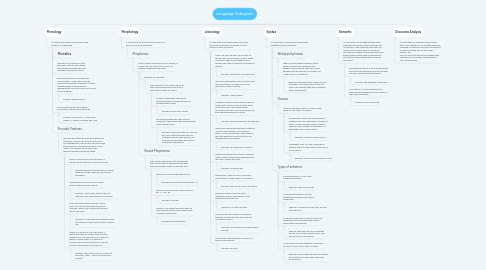
1. Phonology
1.1. It is the study of how sounds are formed together in a language.
1.1.1. Phonetics
1.1.2. Phonetics is an extension from phnology. This last one studies how sounds are organized, and phonetics the specific sound.
1.1.3. There are symbols to represent the pronunciation, "They come from the International Phonetic Alphabet, a system devised to give a unique written representation for each sound that occurs in any language."
1.1.3.1. Example: legend ledʒnd
1.1.4. This symbols are divided in three: consonants, vowels and diphthongs
1.1.4.1. Example: consonant: v- voice, have; vowels: a- father; Dipthong: æɔ- now
1.1.5. Prosodic Features
1.1.5.1. We use them when we pronounce groups of segments, speech can be very boring, and incomprehensible if we do not use it since we would speak in a monotonous voice. It also helps us to express our emotions and feelings through the way we speak.
1.1.5.1.1. Timing: Is how fast or slow we speak, it shows how excited we are when we speak.
1.1.5.1.2. Loudness: how loud or soft we speak usually determines our feelings
1.1.5.1.3. Pitch: the pitch and the melody of your voice can rise and fall depending on the situation. There is also meaning in the way we use our pitch.
1.1.5.1.4. Stress: If a syllable or word has stress, it means that they are louder in pitch, which makes them more prominent, it is useful to identify certain words in a speech. In English, the nouns are stressed on the first syllable and the verbs in the second.
2. Morphology
2.1. It is the study of the structure and form of words. Work with morpheme.
2.1.1. Morphemes
2.1.1.1. Is the smallest meaningful unit of speech, it means that you cannot have more fun without changing its meaning.
2.1.1.1.1. Example: Car, Random
2.1.1.1.2. Bound Morphemes
3. Lexicology
3.1. It is the study and categorization of words, into groups and these are known as word classes or parts of speech.
3.1.1. Noun and noun phrases: nouns refer to things, they can be people, objects, ideas or qualities, they are the head of noun phrases and they can function as subject or objects.
3.1.1.1. Example: Josh drives to an awful job
3.1.2. Vebs and verb phrases: they are words that describe actions, but they can also be processes, states or events.
3.1.2.1. Example: I like to dance
3.1.3. Auxiliaries: They are subclasses of verbs or helper verbs, there are two primary types and modal ones. The modals always accompany the verb, but the primaries can keep themselves being full verbs.
3.1.3.1. Example: She had planned it another way
3.1.4. Adjectives: describe properties or states of nouns or noun phrases, or sometimes verbs. In adjective phrases, adjectives are the main head their main function is as a modifier with noun phrases.
3.1.4.1. Example: The tall giraffe is eating
3.1.5. Adverb: are words that modify or describe verbs or other adverbs and describe things like place, manner and time.
3.1.5.1. Example: He swims well
3.1.6. Prepositions: They link nouns, pronouns and phrases to other words in a sentence.
3.1.6.1. Example: She lost her ring at the beach
3.1.7. Pronouns: replace nouns to avoid repetitions or give clarifications, most prepositions are personal
3.1.7.1. Example: It is i who am sorry
3.1.8. Conjunctions: link clauses or sentences together, coordinators link like units and include and, but, or.
3.1.8.1. Example: Her favorite colors were purple and red.
3.1.9. Determiners: determines the amount of a noun or noun phrase.
3.1.9.1. Example: his book
4. Syntax
4.1. It is the study of how words are grouped together to form sentences.
4.1.1. Words and phrases
4.1.1.1. When a native English speakear, talk or writes, it divides the sentences into groups of similar words, these are called phrases and they function as a single unit in the syntax of a sentence.
4.1.1.1.1. Example: The destruction of the city was inevitable, “The destruction of the city” (main noun phrase) that “was inevitable” (main verb phrase).
4.1.2. Clauses
4.1.2.1. Simple sentences consist of a main clause. There are two types of clauses:
4.1.2.1.1. Independent: These can stand alone in a sentence and still make sense. Sometimes when a simple sentence does not make sense by itself, another independent or a dependent one is joined with it.
4.1.2.1.2. Dependent: This, as it says, depends on another clause to make grammatical sense in a sentence.
4.1.3. Types of sentence
4.1.3.1. A simple sentence: is just a one independent clause.
4.1.3.1.1. Example: The train was late
4.1.3.2. A compound sentence: are two independent clauses joined with a coordinator.
4.1.3.2.1. Example: Joe waited for the train, but the train was late
4.1.3.3. A complex sentences: is made up with one independent and one dependent clause joined with a subordinator.
4.1.3.3.1. Example: Because Mary and Samantha arrived at bus station before noon, i did not see them at the station.
4.1.3.4. A compound-complex sentence: comprises for one or more of each type of clause.
4.1.3.4.1. Example: Laura forgot her friend´s birthday, so she sent her a card when she finally remembered.
5. Semantic
5.1. It is the study of the meaning behind the language, the way the letters are seen has no relation to the sound we make with our mouth, but we know what it sounds like, because they taught us how each letter and letter patterns sounds and is pronounced . The letters have an agreed upon meaning and sound.
5.1.1. Denotative meaning: It is the meaning that you find in the dictionary and the one that is usually associated with the word.
5.1.1.1. Example: The blueberry is very blue
5.1.2. Connotation: It is the meaning that a person gives depending on the context, or their own experience.
5.1.2.1. Example: Susy is very blue