


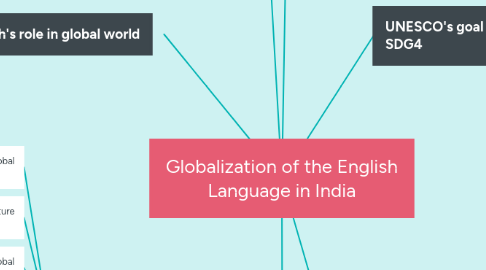
1. Access to English Language Instruction
1.1. Limited English teacher qualifications
1.2. Few schools offer English instruction and those that do are private and more costly schools
1.3. The popularity of English-medium education is rising in India and other Asian countires
1.3.1. This leads to regional divides based on socioeconomic class
1.3.2. This poses its own set of issue which might be out of the scope of my research
1.3.2.1. Jayadeva, S. (2019). English‐Medium: Schooling, Social Mobility, and Inequality in Bangalore, India. Anthropology & Education Quarterly, 50(2), 151-169. doi:10.1111/aeq.12287
1.4. Inequitable access to English language instruction
1.4.1. Based on socioeconomic class
1.4.1.1. Leading to a dichotomy and cyclical progression towards success based on class
2. Colonizing aspects of English language
2.1. English is the language of the global economy
2.1.1. This leads more people to want to learn English to succeed in the workforce
2.2. English langauge education limits the future of those who are of lower classes
2.3. English education emphasized global relevance of English
2.4. Vaish, V (2005). A Peripherist View of English as a Language of Decolonization in Post-Colonial India, Language policy (4)
2.5. Bhattacharya, U. (2016). Colonization and English ideologies in India: A language policy perspective. Language Policy, 16(1), 1-21. doi:10.1007/s10993-015-9399-2
2.6. Jeyaraj, J (2015). Are we decolonizing or recolonizing colonial English education policy?, SSRN Electronic Journal
3. English's role in global world
3.1. English has become an international lingua franca
3.1.1. English is used for scientific research, politics, telecommunications, international relations, global policy, and many more highly influential topics
3.1.1.1. Spring, J. H. (2015). Globalization of Education. In Globalization of education: An Introduction (pp. 1-30). New York, NY: Routledge.
3.2. Proctor, L. M. (2014). English and Globalization in India: The Fractal Nature of Discourse. Journal of Linguistic Anthropology, 24(3), 294-314. doi:10.1111/jola.12056
4. UNESCO's goal of Achieving SDG4
4.1. Educational Sustainability by 2030
4.1.1. Globalization of the English language has the potential to endanger educational sustainability by illustrating linguistic inequity
4.2. Global educational prosperity
4.3. Inclusive and equitable education goals
4.3.1. Policy often omits language's role in promoting equity
4.4. Teacher education
4.4.1. There is a major lack of teacher education in the English language. The lack of proficiency leads to limited learning
4.5. UNESCO. (2016). Education for people and planet: creating sustainable futures for all: global education monitoring report 2016.
4.6. No mention of language in SDG 4
4.6.1. No mention of access to language or its role in Global Citizenship