

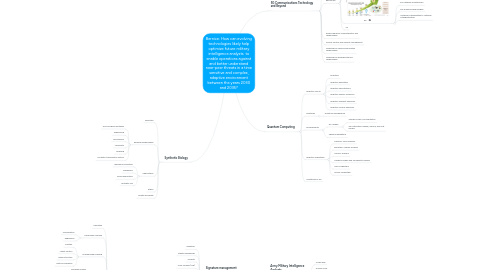
1. Signature management technology
1.1. Definition
1.2. Stealth Technology
1.3. Visibility
1.4. Near-Infrared (NIR)
1.5. NIR Image Converters
1.6. USSOCOM Science and Technology
1.7. Fibrotex Technologies
1.8. Ultra-Lightweight Camouflage Net Systems (ULCANS)
2. Synthetic Biology
2.1. Definition
2.2. Enabling Technologies
2.2.1. DNA and gene synthesis
2.2.2. Sequencing
2.2.3. Microfluidics
2.2.4. Modularity
2.2.5. Modeling
2.2.6. Synthetic transcription factors
2.3. Applications
2.3.1. Biological computers
2.3.2. Biosensors
2.3.3. Space exploration
2.3.4. Synthetic life
2.4. Ethics
2.5. Health and safety
3. Machine Learning
3.1. Definition
3.2. Supervised Learning
3.2.1. Classification
3.2.2. Regression
3.3. Unsupervised Learning
3.3.1. Clusters
3.3.2. Latent Factors
3.3.3. Graph Structure
3.3.4. Matrix Completion
3.4. Models
3.4.1. Gaussian models
3.4.2. Generative models for discrete data
3.4.3. Linear Models
3.4.4. Directed graphical models
3.4.5. Adaptive basis function models
3.4.6. Markov and hidden Markov models
3.4.7. Deep learning
3.5. Limitations
3.5.1. Bias
3.6. Ethics
4. Quantum Computing
4.1. Quantum circuit
4.1.1. Definition
4.1.2. Quantum algorithms
4.1.3. Quantum Permutations
4.1.4. Quantum Fourier Transform
4.1.5. Quantum Wavelet Transform
4.1.6. Quantum Cosine Transform
4.2. Obstacles
4.2.1. Quantum decoherence
4.3. Developments
4.3.1. QC models
4.3.1.1. Turing's Model of Computation
4.3.1.2. The Alternative Goedel, Church, and Post Models
4.3.2. Physical realizations
4.4. Quantum Algorithms
4.4.1. Deutsch-Jozsa Problem
4.4.2. Bernstein-Vazirani Problem
4.4.3. Simon's Problem
4.4.4. Machine Models and Complexity Classes
4.4.5. Shor's Algorithm
4.4.6. Grover's Algorithm
4.5. Limitations of QC
5. 5G Communications Technology and Beyond
5.1. 5G Standardization
5.1.1. Architecture Options
5.2. Beyond 5G
5.2.1. Integrated Access-Backhaul
5.2.2. Operation in Unlicensed Spectra
5.2.3. Non-Orthogonal Multiple Access
5.2.4. Machine-Type Communication
5.2.5. 6G
5.2.5.1. 6G Network Architectures
5.2.5.2. Key Enabling Technologies
5.2.5.3. Network Softwarization to Network Intelligentization
5.2.6. 7G