
Method, Methodology, Language teaching, First, and Second Language acquisition theories

Qualitative research from different philosophical perspectives will be exposed in order to better understand its usefulness and relevance.

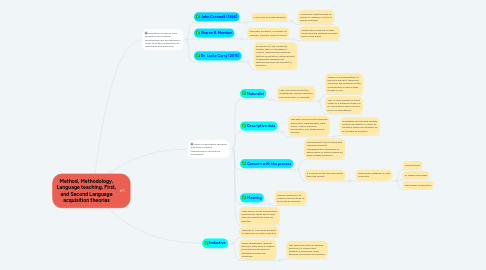
1. Inductive
1.1. Theories or concepts are built on the basis of data collection.
1.2. When researchers develop theories, they have to spend time with participants to experience particular situations.
1.2.1. This approach uses an upward direction to understand situations, behaviors, build theories, and reach conclusions.
2. Types of qualitative research that have common characteristics and similar procedures
2.1. Naturalist
2.1.1. They are observed by the investigator, whose presence may be known or unknown.
2.1.1.1. There is no manipulation of the environment; therefore, activities are observed in the environment in which they usually occur.
2.1.1.2. This is used during the initial stage of a research study for its descriptive value and as a basis for hypotheses.
2.2. Descriptive data
2.2.1. The data could involve interview transcripts, photographs, field notes, videos, personal documents, and other official records.
2.2.1.1. Qualitative articles and reports contain quotations in order to narrate a particular situation as accurately as possible.
2.3. Concern with the process
2.3.1. Sandelowski (2000) noted that research presents comprehensive narratives of phenomena or events based on open-ended questions.
2.3.2. It focuses on the process rather than the results.
2.3.2.1. Three main methods of data collection
2.3.2.1.1. Focus groups
2.3.2.1.2. In-depth interviews
2.3.2.1.3. Participant observation
2.4. Meaning
2.4.1. The key element is to capture perspectives as accurate as possible.
2.5. They focus on the assumptions participants make about their lives and what they take for granted.
3. Qualitative research from different philosophical perspectives will be exposed in order to better understand its usefulness and relevance.
3.1. John Creswell (1994)
3.1.1. A process of understanding
3.1.1.1. A different methodology of inquiry to explore a social or human problem.
3.2. Sharan B. Merriam
3.2.1. Professor emeritus, University of Georgia, Merriam affirms (2009)
3.2.1.1. People give meaning to their world and the experiences they have in the world.
3.3. Dr. Leslie Curry (2015)
3.3.1. Professor at Yale University, explain that is a strategy to collect, organise and interpret textual information systematically to generate insights into phenomena that are difficult to measure.