


1. Lab
1.1. เจาะเลือด (แขนเทียม 1 ชม. & แขนจริง 1.30 ชม.) (แบ่งสองกลุ่ม สลับกัน)
1.2. G4-"Specimen collection (Lecture) วิดีโอสาธิตเจาะเลือด (ขั้นตอน)"
1.3. G5-Serum Protein electrophoresis
1.4. G6-Protein purify
1.4.1. salting-in, salting-out
1.4.2. protein free filtrate
1.5. G7 Biomolecule in urine
1.5.1. Lipid
1.5.2. ketone
1.5.3. Glucose
1.5.4. Protein
1.6. G8-Extract DNA
1.7. G9-Labเอนไซม์ โคเอนไซม์และปฏิกิริยาทางชีวเคมี
1.8. G10-Lab Ca Mg
1.9. Principle of detection
1.9.1. E15-Lab: Steroid drug analysis by thin layer chromatography
1.9.2. E12-Principle and applications of paper, TLC & column chromatography in clinical chemistry
1.10. G1-Practical application of GLP (Lab safety, pipette, เครื่องแก้ว & Cleaning lab glassware) (Lec & Lab)
1.11. G2-น้ำและบัฟเฟอร์ การเตรียมสารเคมี (Lec + Lab)
1.12. G3-Calibrating cuvette (1.30. ชม)
2. Med biochem 3(3-0-6)
2.1. H1-ส่วนประกอบของร่างกาย 1.5h
2.2. H2-การย่อยและการดูดซึมอาหาร 1.5h
2.3. H3-เมตาบอลิซีมของพลังงานและการสังเคราะห์พลังงานระดับเซลล์ 1h
2.4. H4-เมตาบอลิซึมของคาร์โบโฮเดรต 1.5h
2.5. H5-เมตาบอลิซึมของกรดอะมิโนและโปรตีน 1.5h
2.6. H6-เมตาบอลิซึมของลิพิดและโคเลสเตอรอล Lipid and Lipoprotein 3h
2.7. H7-เมตาบอลิซึมของกรดนิวคลีอิก 1h
2.8. H8-เมตาบอลิซึมของสารอาหารเชิงบูรณาการ 2h
2.9. H9-ยีนและดีเอ็นเอ 3h
2.10. H10-เคมีของเลือดและปัสสาวะ 3h
2.11. H11-วิตามินและแร่ธาตุ 4h
2.11.1. Trace element
2.11.1.1. vitamin + ความผิดปกติ
2.12. H12-น้ำ เกลือแร่ บัฟเฟอร์ในร่างกาย 4h
2.12.1. Blood gas & acid-base balance (2h)
2.12.2. (A7)-Fluid Balance and Osmolality (2h)
2.13. H13-ชีวเคมีของฮอร์โมน 1.5h
2.14. H14-Oxidative stress & antioxidant 2h
2.15. H15 (C3)-General aspect of enzymes & principle of diagnostic enzymes 2h
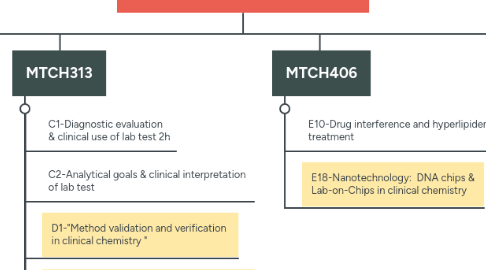
3. MTCH309
3.1. A1-"Course orientation & An Overview of CC & Introduction of Lab in CC 3h
3.2. A12-Quality control in Clin Chem Pre-analytical phase 2h
3.3. A13-Quality control in Clin Chem Post-analytical phase 1
3.4. A14-Quality control in Clin Chem Analytical phase 3h
3.5. A15-Quality control planning 3h
3.6. A2-Hyperglycemia & Hypoglycemia 3h
3.7. A3- Dyslipidemia & CVD &AMI & cardiac marker 6h
3.8. A4-Plasma protein and Other body fluids in Clinical Chemistry 3h
3.9. A5-Non-protein nitrogen determination & renal function test in Clinical Chemistry 3h
3.10. A8-Electrolyte Disturbances 2h
3.11. Acid-base disorder 2h
3.12. C4-Liver anatomy & pathophysiology 1h
3.13. C5-Lab investigation in hepatic & hepatobiliary diseases 4h
3.14. C20-"Automation & point-of-care testing in clinical chemistry 3h
3.15. E20-Principle of biosensors in clinical chemistry 1h
3.16. E21-Application of biosensors in clinical chemistry 1h
4. MTCH310 1(0-3-6)
4.1. D2-"How to deal with risk & safety in lab practice"
4.2. B1-"Demo: Determination of Elec & Blood gas"
4.3. B2-Quality Control Planning (Practice)
4.4. B4-Sample analysis (principle of analysis, STD&calibration curve, one-point cal, QC)
4.5. B7-Determination of Glucose, Total Cholesterol and Triglyceride
4.6. B8-Determination of Total Protein and Albumin
4.7. D6-Kinetic technique of GGT assay
4.8. D3-End-point technique of ALP assay
4.9. B9-Determination of Creatinine and Uric acid & เจาะเลือด
4.10. B11-Lab Sim Planning
4.11. B12-Lab. Simulation I & II & เจาะเลือด
4.12. B13-นักศึกษารายงาน Lab Simulation I & II
4.13. A9-Measurement of Electrolytes
5. MTCH313
5.1. C1-Diagnostic evaluation & clinical use of lab test 2h
5.2. C2-Analytical goals & clinical interpretation of lab test
5.3. D1-"Method validation and verification in clinical chemistry "
5.4. A16-Concept of Traceability & Uncertainty
5.5. C6-Lab investigation in pancreatic diseases
5.6. C7-Lab investigation in bone diseases Osteoporosis
5.7. C12-Hypothalamic & pituitary hormones
5.8. D4-Determination of bilirubin
5.9. C13-Lab investigation in clinical endocrinology
5.9.1. E11-Immunochemical diagnostics and automations in clinical chemistry
5.10. C14-Parathyroid hormone
5.11. C15-Hormones in growth & development
5.12. C16-Hormones in diabetes mellitus
5.13. C17-Hormones in reproductive function
5.14. Biochemical changes
5.14.1. E1-Biochemistry of pregnancy and laboratory assessment
5.14.2. E2-Prenatal Neonatal and pediatric laboratory assessment
5.14.3. E6-Laboratory testing for anti-ageing medicine
5.14.4. E9-Biochemistry of exercise
5.15. C18-Hormones in adrenal function
5.16. C19-Hormones in thyroid function
5.17. C21-Tumor markers & their clinical application
5.18. C22-Inborn error of metabolism
5.19. D7-Introduction to clinical endocrinology (เทพธารินทร์)
5.20. D8-Healthcare professional services in endocrine clinic (เทพธารินทร์)
5.21. D9-Healthcare professional services in IVF technology (เจตนิน)
5.22. D10-Laboratory application for IVF technology
6. MTCH406
6.1. E10-Drug interference and hyperlipidemia treatment
6.2. E18-Nanotechnology: DNA chips & Lab-on-Chips in clinical chemistry
7. Needs
7.1. Brief
7.1.1. Organization
7.1.1.1. โครงสร้าง
7.1.1.2. Function
7.1.1.3. Section/Service ที่เปิดบริการ
7.1.1.4. HR
7.1.1.5. อุปกรณ์ +การจัดการเครื่องมือ
7.1.1.6. Document
7.1.1.6.1. QM
7.1.1.6.2. QP
7.1.1.6.3. WI
7.1.1.6.4. Record
7.1.1.6.5. LIS
7.2. Management
7.3. Process
7.3.1. Pre-analysis
7.3.2. Analysis
7.3.3. Post-analysis
7.3.4. Process control
7.3.4.1. สภาพสิ่งแวดล้อม
7.3.4.1.1. Test
7.3.4.1.2. Staff
7.3.4.2. Workflow
7.3.4.2.1. ผู้ป่วย
7.3.4.2.2. sample prep
7.3.4.2.3. Result report
7.3.4.2.4. การส่งต่อ
7.4. Safety
8. สภา
8.1. Test request
8.2. Ident คนไข้
8.3. Pre-anlytical
8.3.1. Transport & storage specimen
8.3.2. Patient prep
8.3.3. Specimen collection
8.3.4. Sample prep
8.4. คำแนะนำ
8.4.1. การสื่อสารกับคนไข้
8.4.2. บุคคลากร
9. CLO work-based
9.1. soft-skill
9.1.1. การสื่อสาร
9.2. Analytical phase
9.2.1. Sample prep
9.2.2. สามารถประเมินลักษณะทางกายภาพของสิ่งส่งตรวจได้
9.2.2.1. Interfere from specimen
9.2.2.2. Serum index
9.2.2.2.1. Icteric
9.2.2.2.2. Lipemic
9.2.2.3. Sample rejection
9.2.3. ระบบพร้อมทำงานไหม
9.2.3.1. IQC
9.2.3.2. EAQ
9.2.3.3. QC Planning
9.2.3.4. MV
9.2.3.5. Traceability
9.2.3.6. Average of norm (AON)เอาข้อมูลผู้ป่วยมา
9.2.4. Principle
9.2.4.1. Photometry
9.2.4.2. Immunochem
9.2.5. Automate
9.2.5.1. Maitenance
9.2.5.1.1. Daily
9.2.5.1.2. Montly
9.2.5.2. Reagents
9.2.5.2.1. Ready to use
9.2.5.2.2. Need preparation
9.2.5.3. Calibration curve
9.2.6. Pack insert
9.2.6.1. Dilution
9.3. Post-Analytical
9.3.1. Technical level level
9.3.1.1. Approve
9.3.1.1.1. Approve by
9.3.1.2. Verify
9.3.1.2.1. Analytical correlation
9.3.1.3. Uncertainty
9.3.2. Biological level
9.3.2.1. การแปลผลเทียบกับผลก่อนหน้า
9.3.2.2. เทียบ ref range
9.3.3. Nosological level
9.3.4. การรายงานค่าวิกฤต
9.3.5. Reported by
9.3.5.1. Technical
9.4. การให้คำปรึกษา
10. CLO: Clinical
10.1. แนะนำวิธีการเตรียมตัวและการเก็บตัวอย่างส่งตรวจกับผู้รับบริการตามมาตรฐานที่เกี่ยวข้องได้
10.2. ประเมินลักษณะทางกายภาพของสิ่งส่งตรวจแลผลกระทบต่อการวิเคราะห์ได้
10.3. เปรียบเทียบวิธีการเตรียมน้ำยา (น้ำยา, calibrator & control) ในแต่ละบริบทได้
10.4. สามารถทำ daily maintenance Calibration curve ได้
10.5. ประเมินความพร้อมของระบบในการทำงาน
10.5.1. QC planing
10.5.2. การแปลผล QC
10.5.3. MV
10.5.4. Traceability
10.5.5. อธิบาย QC ที่ใช้ได้
10.5.6. Average of norm (AON)
10.5.7. EQA