

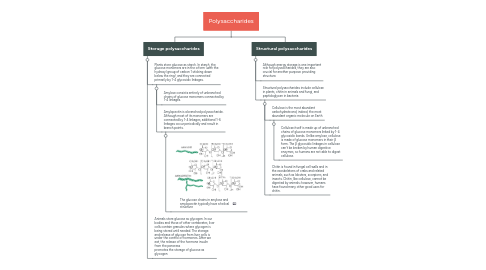
1. Storage polysaccharides
1.1. Plants store glucose as starch. In starch, the glucose monomers are in the α form (with the hydroxyl group of carbon 1 sticking down below the ring), and they are connected primarily by 1-4 glycosidic linkages.
1.1.1. Amylose consists entirely of unbranched chains of glucose monomers connected by 1-4 linkages.
1.1.2. Amylopectin is a branched polysaccharide. Although most of its monomers are connected by 1-4 linkages, additional 1-6 linkages occur periodically and result in branch points.
1.1.2.1. The glucose chains in amylose and amylopectin typically have a helical structure
1.2. Animals store glucose as glycogen. In our bodies and those of other vertebrates, liver cells contain granules where glycogen is being stored until needed. The storage and release of glucose from liver cells is under the control of hormones. After we eat, the release of the hormone insulin from the pancreas promotes the storage of glucose as glycogen
2. Structural polysaccharides
2.1. Although energy storage is one important role for polysaccharides, they are also crucial for another purpose: providing structure.
2.2. Structural polysaccharides include cellulose in plants, chitin in animals and fungi, and peptidoglycan in bacteria
2.2.1. Cellulose is the most abundant carbohydrate and, indeed, the most abundant organic molecule on Earth
2.2.1.1. Cellulose itself is made up of unbranched chains of glucose monomers linked by 1-4 glycosidic bonds. Unlike amylose, cellulose is made of glucose monomers in their β form. The β glycosidic linkages in cellulose can't be broken by human digestive enzymes, so humans are not able to digest cellulose.
2.2.2. Chitin is found in fungal cell walls and in the exoskeletons of crabs and related animals, such as lobsters, scorpions, and insects. Chitin, like cellulose, cannot be digested by animals; however, humans have found many other good uses for chitin.