

The Importance of Written Communication Skills in Nursing
por Tina Will Schatz
1. patients want clear instructions
1.1. helps with overall treatment plan after discharge
1.1.1. consistent reference point for patients
1.1.1.1. patients will adhere to treatment plan when it is well written and easy to understand
1.2. consistent reference points for patients
1.3. patients will adhere to treatment plan when it is well written and easy to understand
2. It is the nurse's professional responsibility
2.1. provides protection should a question arise
2.1.1. "If you didn't write it, you didn't do it"
2.1.1.1. poor clinical notes undermine the quality of care
2.2. poor clinical notes undermine the quality of care
2.3. "If you didn't write it, you didn't do it"
3. What should the nurse's note contain?
3.1. subjective information
3.2. objective information
3.3. assessment
3.4. plan
3.5. What you need to know about writing a progress note (Nursing School Lesson)
4. Electronic communication is the future, but it is less personal and can be misinterpreted
4.1. Elderly patients that are not computer savvy
4.2. Helping Seniors Cross the Digital Divide | Isabella Martinez | TEDxTemecula
5. Why writing matters in nursing
5.1. discuss stories from patients
5.2. evidence of critical thinking
5.3. exploration of nursing literature
5.4. evidence of understanding of learning activities
5.5. documentation of knowledge
6. Verbal lines of communication
6.1. nurse/nurse
6.2. nurse/doctor
6.3. nurse/administration
6.4. Communication in Multidisciplinary Healthcare Teams
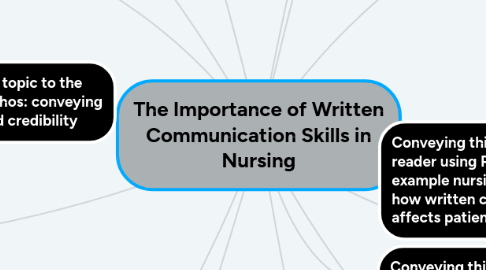
7. Conveying this topic to the reader using Ethos: conveying main topics and credibility
8. Improves critical thinking skills
8.1. encourages the nurse to organize thoughts an evaluate relevance of their response
8.1.1. improves the decision making
8.1.1.1. helps to share views and ideas
8.1.1.1.1. improves appropriate language for an intended audience
8.2. improves decision making
8.3. helps share views and ideas
8.4. improves appropriate language intended audience
9. means of documentation in nursing
9.1. contributes to effective and efficient operations of the facility
9.1.1. makes switching of shifts flow easier
9.1.1.1. gives nurses a concrete treatment plan in writing
9.1.1.1.1. hospitals and other facilities able to share and collaborate knowledge on best practices
9.2. makes audience simpler: ex. court defense
9.3. hospitals and other facilities able to share and collaborate knowledge on best practices
9.4. gives nurses a concrete treatment plan in writing
9.5. makes switching of shifts flow easier
9.6. Documentation: Avoiding the Pitfalls
10. Forms of written communication
10.1. nursing notes
10.2. questionnaires
10.3. guidelines
10.4. discharge summary
10.5. policies/research
10.5.1. interviews with patients
10.6. journal articles
10.6.1. virtual simulations
10.6.1.1. posters
10.7. social media
10.7.1. grants