


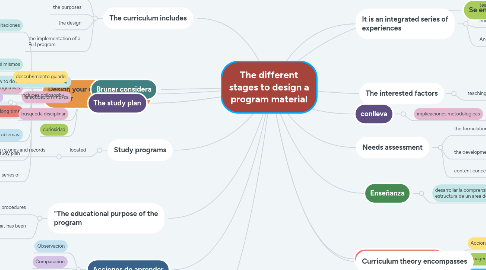
1. Design your own program as a teacher
1.1. superar las limitaciones
1.1.1. del
1.1.1.1. aprendizaje mecanico
1.1.1.2. aprendizaje tradicional
1.1.2. in service can take a long time
1.2. Estimulacion propia por si mismos
1.2.1. de forma
1.2.1.1. hipotetica
1.2.1.2. sistematica
1.3. estrategias metacognitivas
1.3.1. para aprender
1.4. in service can take a long time
1.4.1. Autoestima
1.4.2. and it is also difficult to teach
1.5. Solución creativa de los problemas.
1.6. The study plan
1.6.1. includes philosophy,
1.6.1.1. purposes,
1.6.1.1.1. design the implementation
1.7. is an integrated series of
1.7.1. teaching-learning experiences,
1.7.1.1. the ultimate goal of which is to bring students
1.7.1.1.1. to a particular state of knowledge.
2. Bruner considera
2.1. how to do it to teachers in training.
2.1.1. promueve la curiosidad
2.2. la educación implica
2.2.1. cambio de paradigma en
2.2.1.1. los métodos educativos tradicionales
3. The study plan
3.1. descubrimiento guiado
3.2. includes philosophy,
3.2.1. purposes,
3.2.1.1. design the implementation
3.3. busqueda disciplinar
3.4. curiosidad
4. Acciones de aprender
4.1. Observacion
4.2. Comparacion
4.3. Analisis
4.3.1. Semejanzas
4.3.2. Diferencias
5. EJEMPLOS
5.1. Incentivar al estudiante a
5.1.1. generar habilidades y destrezas
5.1.2. desemvolbimiento comunicativa
5.1.3. motivacion hacia la creatividad y el descubrimiento
5.1.4. mantener un ambiente de estudio armonioso
5.1.5. obtener la capacidad de analizar informacion
6. Study programs
6.1. located
6.1.1. in stories and records
6.1.1.1. it really happens in the classroom.
7. The curriculum includes
7.1. The philosophy
7.2. the purposes
7.3. the design
7.4. the implementation of a Full program.
8. "The educational purpose of the program
8.1. content teaching procedures
8.1.1. the learning experience that will be needed
8.1.1.1. to achieve this purpose
8.2. Some means of evaluating what has been achieved
8.2.1. or not for educational purposes
9. Enseñanza
9.1. desarrollar la comprension general de la estructura de un area de conocimiento
10. Se enfoca en la evolución de
10.1. las habilidades cognitivas
10.2. estructura adecuada de contenidos educativos
10.3. medio ambiente influyente en el
10.3.1. desarrollo intelectual
11. conlleva
11.1. implicaciones metodologicas
11.1.1. La motivacion
11.1.2. La actitud del estudiante
11.1.3. El uso de informacion
11.1.4. El manejo de informacion en la resolucion de problemas
11.1.5. La compatibilidad
11.1.6. El despliegue sobre si mismo
11.1.7. La practica de habilidades
11.1.8. el despiegue sobre si mismo
12. Se adquiere informacion
12.1. Acciones
12.2. Imagenes
12.3. Lenguaje
13. It is an integrated series of experiences
13.1. teaching-learning,
13.2. end goal
13.2.1. students in a particular state of knowledge.
13.2.1.1. And the syllabus is the specification
13.3. And the syllabus is the specification
13.3.1. and the order of the content of a course or courses.
14. The interested factors
14.1. teaching resources
14.1.1. time
14.1.1.1. for program design
14.1.1.1.1. instead of just following
15. Needs assessment
15.1. the formulation of goals and objectives
15.1.1. goals
15.1.2. and objectives
15.2. the development of materials,
15.2.1. the design of an evaluation plan,
15.2.1.1. the organization of the course
15.3. content conceptualization is described
15.3.1. as a framework of the course development process
16. Curriculum theory encompasses
16.1. The philosophy
16.2. value systems
16.3. the main components of the curriculum: purposes,
16.3.1. content,
16.3.2. evaluation
16.3.3. evaluation process by which
16.3.4. the study plans are
16.3.4.1. develop,
16.3.4.2. implement
16.3.4.3. they evaluate