Metacognitive problems to evaluate one`s learning or the illusion of learningpor Marcelo Baez Meza
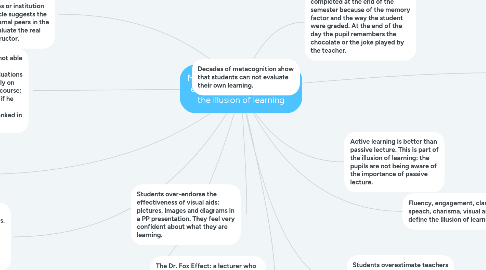
1. Decades of metacognition show that students can not evaluate their own learning.
2. Students over-endorse the effectiveness of visual aids: pictures, images and diagrams in a PP presentation. They feel very confident about what they are learning.
3. The Dr. Fox Effect: a lecturer who talks non-sense but is very effective in his ways of sharing the information with humor. Students associate effective learining with easy, enjoyable and fluent experiences.
4. Instructors who grade leniently received better grades than instructors that grade more conservately. Instructor can boost their grades by giving away candies, pizza or chocolate or being affectionate with the students.
5. Students are not capable of identifying teaching techniques. According to some surveys, pupils tend to learn more from passive techniques and approaches that required less effort.
6. In order to get recognition and respect, instructors tend to incorporate poor techniques with no learning impact whatsoever.
7. Students evaluations are not able to measure the learning effectriveness. Those evaluations are very subjective and rely on the best memories of the course: if the instructor was nice, if he gave good grades or even chocolates, they will be ranked in the most posiitive way.
8. This kind of instructors do not have to be responsible of curricula changes or institution rubrics. The article suggests the presence of external peers in the classroom to evaluate the real value of the instructor.
9. According to some studies, the test scores of the students taught by a trained professor were not different from the test scores of the students taught by other instructors. The textbook and syllabi were exactly the same. The only difference was the instructor.
10. Students overestimate teachers whose lectures are very enthusiastic. The illusion of learning is simple: they think they are learning more because the teacher is good.
11. Fluency, engagement, clarity of speach, charisma, visual aids define the illusion of learning.
12. Active learning is better than passive lecture. This is part of the illusion of learning: the pupils are not being aware of the importance of passive lecture.
13. Students evaluations can not be completed at the end of the semester because of the memory factor and the way the student were graded. At the end of the day the pupil remembers the chocolate or the joke played by the teacher.