

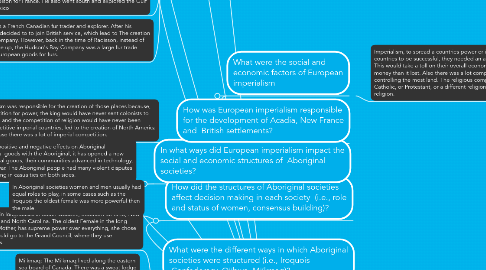
1. Who were the key figures in the French exploration and settlement of North America?
1.1. Pierre de Monts: He was one of the first French to build a permanent settlement in New France. Pierre de Monts recived a monopoly, which led him to sail to America with a map maker and explorer named Samuel de Champlain, together they set up a colony in the Bay of Fundy, they named the newly built colony Acadia.
1.2. Jacques Cartier: Cartier first visits North America in the July of 1534. During his first visit, he landed in a place he called Gaspe, there at Gaspe he met a group of Iroquois who were fishing in the area, the leader of this group was named Donnacona, he took 2 of his sons to Europe with him to prove what he had saw in America. In 1535 Cartier returned with Donnacona's sons, who guided them in land, via the St. Lawrence River. After staying a cold harsh winter Cartier returned to Europe. Later in 1542, Cartier returned to set up a colony, but with colder winters than they were expecting, disease, and risk of war, the colonists abandoned their colony and returned to Europe. Although the colony had failed, Cartier had brought back a great deal of information about America, which paved the road for future colonies.
1.3. Samuel de Champlain: He worked to help build Acadia, as well worked to trade furs with the first nation communities. Samuel de Champlain spent 27 years in New France, during this time, he went back to France 8 times to persuade the king to send more settlers and supplies to support the growing colony of Acadia. As well Champlain made alliances with many of the first nation tribes, the alliances weren't just local tribes, he traveled inland to the great lakes, where he made an alliance with a group known as the Huron. Samuel de Champlain set Acadia on the course for success.
1.4. King Louis XIV: King Louis the 14th is the reason why so many explorers set out. King Louis the 14th came into power after some colonies of New France were built. King Louis wanted to be more powerful than all the other kings of Europe, so also wanted many furs from trading. So he sent supplies and men to support the growing communities.
1.5. Rene Robert Cavelier de la Salle: He was a French explorer who explored the Great Lakes of Canada and United States. He explored the entire Mississippi River, and claimed the Mississippi River Bison for France. He also went south and explored the Gulf of Mexico
1.6. Pierre Radisson: He was a French Canadian fur trader and explorer. After his brother in law and him decided to to join British service, which lead to The creation of the Hudson's Bay Company. However, back in the time of Radisson, instead of selling clothes and make up, the Hudson's Bay Company was a large fur trade company that traded European goods for furs.
2. What were the different ways in which Aboriginal societies were structured (i.e., Iroquois Confederacy, Ojibwa, Mi’kmaq)?
2.1. Iroquois: The Iroquois lived in longhouses in South Quebec, Southern Ontario, New York, Wisconsin, Oklahoma, and North Carolina. The oldest Female in the long house, also known as Clan Mother, has supreme power over everything, she chose who were the chiefs who would go to the Grand Council, where they use consensus to make decisions.
2.2. Mi'kmaq: The Mi'kmaq lived along the eastern sea board of Canada. There was a sweat lodge where elders told stories to the young.
2.3. Ojibwa: Lived around the great lakes. The Ojibwa told many stories to their young. The Ojibwa were involved in a lot of trading with the Europeans.
3. How did the structures of Aboriginal societies affect decision making in each society (i.e., role and status of women, consensus building)?
3.1. In Aboriginal societies women and men usually had equal roles to play, in some cases such as the Iroquois the oldest female was more powerful then the male.
4. What were the social and economic factors of European imperialism
4.1. Imperialism, to spread a countries power or influence through military action. In order for European imperial countries to be successful, they needed an abundant and stable source of raw resources to sustain their might. This would take a toll on their overall economy of the time, but in the long run, imperialism will make more money than it lost. Also there was a lot competition in Europe to be the most powerful king there was, by controlling the most land. The religious competition was just as competitive, each religion, whether it was Catholic, or Protestant, or a different religion altogether. Missionaries were sent everywhere to spread their religion.
5. In what ways did European imperialism impact the social and economic structures of Aboriginal societies?
5.1. European imperialism had a positive and negative effects on Aboriginal communities. By trading metal goods with the Aboriginal, it has opened a new door to first nations, with metal goods, their communities advanced in technology, but with technology, comes war. The Aboriginal people had many violent disputes with European settlers, resulting in casualties on both sides.
6. How was European imperialism responsible for the development of Acadia, New France and British settlements?
6.1. European imperialism was responsible for the creation of those places because, without the competition for power, the king would have never sent colonists to colonize more land, and the competition of religion would have never been sparked. The competitive imperial countries, led to the creation of North America as we know it because there was a lot of imperial competition.
7. What roles did the Royal Government and the Catholic Church play in the social structure of New France (i.e., governor, intendant, Jesuits, religious congregations)?
7.1. In New France, the majority of the population was of the same religion, and nationality. The government and king only encouraged French Citizens who were Catholic to move to New France.
7.1.1. Governor: The Governor was the most powerful member of the Sovereign Council, the Governor was the Kings representative, he was usually a military officer, or a noble. The Governor took charge of the colony, he looked after the safety and defense of the colony, as well as handling relations with allies and enemies.
7.1.2. Intendant: He was the second most important person in the Sovereign Council. He was in charge of day-to-day affairs, such as courts, roads, settlers, and managed the colonies economy. They also take polls, to see what is needed for the colony to run smoothly.
7.1.3. Jesuits: A member of the society of Jesus, founded by a Roman Catholic Church in mid 15 hundreds. This was set up to do missionary work for the Christian religion (Catholic).