


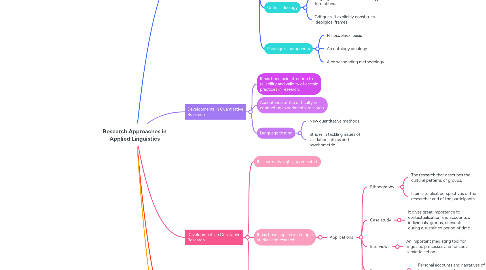
1. Contrasting, combining, expandig paradigms
1.1. Quantitative approaches
1.1.1. Most commonly used in AL. Seen as more objective.
1.1.2. It includes
1.1.2.1. Correlational, survey and multifactorial studies.
1.1.2.2. Experimental studies.
1.2. Qualitative approaches
1.2.1. Interpretative, humanistic orientation, multiple realities.
1.2.2. It encompasses
1.2.2.1. Microethnography and discourse analysis.
1.2.2.2. Conversation analysis.
1.2.2.3. Historical, archival studies.
1.2.2.4. Narrative research.
1.3. Critical ideology
1.3.1. It connects local conditions of language to broder social ideology formations.
1.3.2. Critiques: it explicitly constitues ideoligical frames.
1.4. Paradigm's componets
1.4.1. Philosophical basis
1.4.2. An ontology ideology
1.4.3. A corresponding methodology
2. Developments in Quantitative Research
2.1. It has been paid attention to reliability and validity of certain practices in research.
2.2. Acceptance of the difficulty in conducting experimental research.
2.3. Language testing
2.3.1. New quantitative methods.
2.3.2. Strides in tackling issues of validation, ethics and psychometric.
3. Developments in Qualitative Research
3.1. It is currently highly appreciated.
3.2. It has been applied in multiple studies and research.
3.2.1. Applications
3.2.1.1. Ethnography
3.2.1.1.1. The research that describes the cultural patterns of groups.
3.2.1.1.2. It aims to elicit perspectives of the researcher and of the participants.
3.2.1.2. Case study
3.2.1.2.1. It gives great importance to contextualization and accounts of individuals, groups, or events during a sustained period of time.
3.2.1.3. Interviews
3.2.1.3.1. An important mediating tool for linguistic processes and for social semiotic action.
3.2.1.4. Narrative inquiry
3.2.1.4.1. Personal accounts and narratives of the experiences of language teachers, learners and others.
3.2.1.5. Arts-based research
3.2.1.5.1. It involves dramatic enactments and other forms of artistic expressions.