

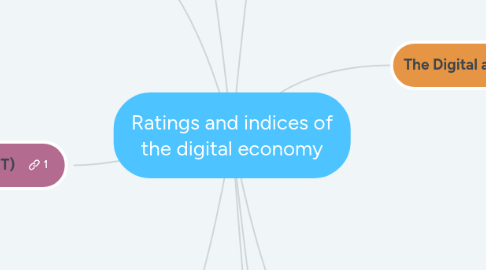
1. Digital Intelligence Index (DII)
1.1. Prepared by
1.1.1. Fletcher School at Tufts Universityy, in partnership with Mastercard
1.2. Data-driven holistic evaluation of the progress of the digital economys, combining more than 358 indicators in two scorecards:
1.2.1. Digital Evolution
1.2.1.1. Supply Conditions
1.2.1.2. Demand Conditions
1.2.1.3. Institutional Environment
1.2.1.4. Innovation and Change
1.2.2. Digital Trust
1.2.2.1. Environment
1.2.2.2. Behavior
1.2.2.3. Attitudes
1.3. Top countries in 2022 (Digital Evolution: State)
1.3.1. 1. Singapore (98.82) 2. United States (89.82) 3. Hong Kong (88.12)
1.3.2. 39. China (61.27) Belarus is not listed
2. Networked Readiness Index (NRI)
2.1. Prepared by
2.1.1. The World Economic Forum in collaboration with INSEAD
2.2. 53 individual indicators that are grouped into 10 categories
2.2.1. Institutions
2.2.2. Expirience
2.3. Top countries in 2022
2.3.1. 1. United States (80.30) 2. Singapore (79.35) 3. Sweden (78.91)
2.3.2. 23. China (68.83) Belarus is not listed
3. E-participation Index (EPART)
3.1. Prepared by
3.1.1. The United Nations E-government Survey
3.2. E-participation framework
3.2.1. E-information
3.2.2. E-consultation
3.2.3. E-decision-making
3.3. Top countries in 2022
3.3.1. 1. Denmark (0,9717) 2. Finland (0,9533) 3. Republic of Korea (0,9529)
3.3.2. 43. China (0,8119) 58. Belarus (0,7580)
4. Global Innovation Index (GII)
4.1. Prepared by
4.1.1. Cornell University, INSEAD, and WIPO in partnership with other organizations
4.2. * 80 indicators across 7 pillars * Includes both quantitative and qualitative data * Survey-based data collection from multiple sources
4.2.1. Human Capital and Research
4.2.2. Infrastructure
4.2.3. Digitalisation
4.2.4. Entrepreneurship
4.2.5. Knowledge and Technology outputs
4.2.6. Creative outputs
4.3. Top countries in 2022
4.3.1. 1. Switzerland 2. United States 3. Sweden
4.3.2. China and Belarus are not listed
5. Includes Digital Evolution Index (DEI)
6. in the Digital Evolution scorecard (90 economies; 160 comparable indicators over 12 years) and Digital Trust scorecard (42 economies; 198 indicators from the latest available year)
7. The ICT Development Index (IDI)
7.1. Prepared by
7.1.1. International Telecommunication Union (ITU)
7.2. Composite index based on 11 indicators that are grouped into three main categories: access, use, and skills
7.2.1. Percentage of households with a computer
7.2.2. Adult literacy rate
7.2.3. Percentage of individuals using the Internet
7.2.4. Mobile-cellular telephone subscriptions per 100 inhabitants
7.2.5. Percentage of the population aged 15-24 years who have completed at least a secondary education
7.2.6. Gross enrolment ratio in tertiary education
7.2.7. Percentage of households with Internet access
7.2.8. Gross enrolment ratio in secondary education
7.2.9. International Internet bandwidth (bit/s) per Internet user
7.2.10. Gross enrolment ratio in primary education
7.2.11. Fixed-telephone subscriptions per 100 inhabitants
7.3. Top countries in 2017
7.3.1. 1. Iceland (8.98) 2. Korea (Rep.) (8.85) 3. Switzerland (8.74)
7.3.2. 32. Belarus (7.55) 80. China (5.6)
8. The Digital and Society Index (DESI)
8.1. Prepared by
8.1.1. The European Commission
8.2. Three-level structure indicator which includes: 1. Dimension 2. Sub-dimension 3. Indicator
8.2.1. Human capital
8.2.1.1. Internet user skills
8.2.1.2. Advanced skills and development
8.2.2. Connectivity
8.2.2.1. Fixed broadband take-up
8.2.2.2. Fixed broadband coverage
8.2.2.3. Mobile broadband
8.2.2.4. Broadband prices
8.2.3. Integration of digital technology
8.2.3.1. Digital intensity
8.2.3.2. Digital technologies for businesses
8.2.3.3. e-Commerce
8.2.4. Digital public services
8.2.4.1. e-Government
8.3. Top countries in 2022
8.3.1. 1. Finland 2. Denmark 3. Netherlands
8.3.2. Belarus and China are not listed
9. World Digital Competitiveness Ranking (WDCI)
9.1. Prepared by
9.1.1. IMD’s World Competitiveness Center (WCC)
9.2. Calculation
9.2.1. 54 criteria were measured – a mixture of external hard data and the IMD Executive Opinion Survey – and arranged into three major groups: future readiness, knowledge and technology.
9.3. Top countries 2022
9.3.1. 1. Denmark 2. USA 3. Sweden
9.3.2. 17. China Belarus is not listed
10. E-Government Development Index (EGDI)
10.1. Prepared by
10.1.1. Division for Public Institutions and Digital Government (DPIDG).
10.1.1.1. Department of Economic and Social Affairs of the United Nations (UN DESA)
10.2. Composite index based on the weighted average of three normalized indices
10.2.1. One-third from the Human Capital Index (HCI)
10.2.2. One-third from the Online Service Index (OSI)
10.2.3. One-third from the Telecommunications Infrastructure Index (TII)
10.3. Top countries in 2022
10.3.1. 1. Denmark (0.9717) 2. Finland (0.9533) 3. Republic of Korea (0.9529)
10.3.2. 43. China (0.8119) 58. Belarus (0.758)
11. Global Connectivity Index (GCI)
11.1. Prepared by
11.1.1. Huawei Technologies Co.,Ltd
11.2. The 40 indicators are analyzed both vertically (Supply, Demand, Experience, Potential) and horizontally (Broadband, Cloud, IoT and AI)
11.3. Top contries in 2020
11.3.1. 1. United States (87) 2. Singapore (81) 3. Switzerland (81)
11.3.2. 22. China (62) 47. Belarus (46)