

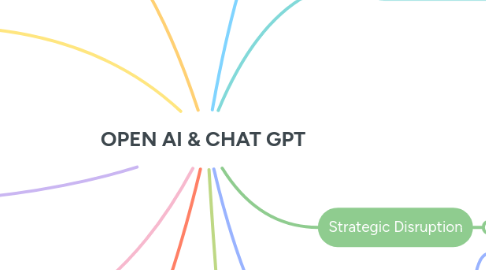
1. Headwinds
1.1. Customer capital
1.1.1. FTC warns of AI hype
1.2. Structural capital
1.2.1. NYT exposes Microsofts Bing Chatbot
1.2.2. Getty Images sues Stability AI for $1.8 Trillion
1.2.3. TTEC Holdings warns of misinformation from Horizontal AI
1.2.4. CCC Intelligent Solutions warns of model drift
1.3. Economic capital
1.3.1. Elon Musk questions OpenAI
1.3.1.1. No longer non-profit
1.3.2. JPM bans employees from using ChatGPT
1.3.3. US Copyright Office rules AI images can't be copyrighted
1.3.4. Paizo bans AI-generated content
1.4. The alignment problem
1.4.1. AI behaving in relation to humans
1.4.1.1. Safeguards must be built in
1.4.2. AI to Prioritize and have the same values as humans
1.4.3. AI may be designed with opposing objectives
1.4.4. As AI becomes autonomous this is a concern
2. THE HYPE
2.1. What area's are generating the most hype?
2.1.1. Predictive analytics
2.1.2. Natural language processing
2.1.3. Healthcare
2.1.4. Autonomous vehicles
2.1.5. Automation
2.2. Cause for concern?
2.2.1. Spread of misinformation
2.2.2. Job loss
2.2.3. Bias and discrimination
2.2.4. Privacy and security
2.2.5. Lack of transparency
2.2.6. Ethical concerns
3. Tailwinds
3.1. AI Advancement
3.1.1. Will increase demand for
3.1.1.1. Computing Power
3.1.1.2. Data Storage
3.2. Timely introduction given current drive for efficiency
3.2.1. AI helps to produce more work at the same time: efficiency
3.2.2. Company will need less workers to produce the same revenue
3.2.3. Current corporate drive: efficiency
3.2.3.1. Evidenced by growing number of layoffs in Tech and Non-Tech
3.3. Layoffs
3.3.1. Tech
3.3.1.1. Deep Cuts from Yahoo, Twilio, Affirm Holdings and Zoom
3.3.1.1.1. Companies announcing cuts: Year-to-date total to 346
3.3.2. Non-Tech
3.3.2.1. News Corp. and Disney are the Latest
3.4. Widespread adoption
3.4.1. global interest
3.4.2. AI literacy
3.4.2.1. https://mailchi.mp/technologyreview.com/ai-literacy-chatgpt-biggest-lesson-for-schools?e=eab8cc19a5
3.4.2.1.1. Uptake in AI tools
3.4.2.1.2. Increased tools for small scale use cases
3.4.3. Institutional education shift
3.4.3.1. Teachers promoting it's use
3.4.3.2. An opportunity to explore bias
3.4.3.3. Evaluation based on prompts
3.4.3.3.1. Less focused on written output
3.4.4. AI PhD Adoption
3.4.4.1. in 2020 almost 70%. of AI PhD's went to companies
3.4.4.1.1. Rather than continuing research in the feild
3.4.4.1.2. 8 fold increase in faculty being hired since 2006
4. Regulations/Legal
4.1. Divided into 3 main topics
4.1.1. governance of autonomous intelligence systems
4.1.2. responsibility and accountability for the systems
4.1.3. privacy and safety issues
4.2. Global Guidance
4.2.1. 2017: First proposed
4.2.2. 2018: G7-backed International Panel on Artificial Intelligence
4.2.3. 2019: Panel was renamed the Global Partnership on AI
4.2.4. 2020: EU published its draft for promoting and regulating AI
4.3. EU AI Act
4.3.1. A proposed European Law on AI
4.3.2. Assigns AI usage to 3 risk categories
4.3.2.1. https://www.forbes.com/sites/nishatalagala/2022/06/29/the-ai-act-three-things-to-know-about-ai-regulation-worldwide/?sh=7d22ac5f379f
4.3.2.1.1. Systems that create an unacceptable risk
4.3.2.1.2. Systems that are high risk
4.3.2.1.3. Other applications
5. Geopolitical Ramifications
5.1. The power dynamic
5.1.1. Nation with the dominant AI
5.1.1.1. Increased efficiency
5.1.1.2. Increased knowledge
5.1.1.3. increased equality
5.1.1.4. higher standard of living
5.1.2. Nation with less dominant AI
5.1.2.1. less efficient
5.1.2.2. less knowledge when compared
5.1.2.3. less equality
5.1.2.4. overall lower standard of living
5.2. Industrial capture
5.2.1. Private AI companies entrenched power
5.2.1.1. Small number of companies control impact
5.2.2. Largest AI models & Big Tech
5.2.2.1. Big Tech's share of models
5.2.2.1.1. 11% in 2010
5.2.2.1.2. 96% in 2021
5.2.3. Lack of public access
5.2.3.1. Due to: Inability to replicate the models
5.2.3.1.1. Huge data sets are required
5.2.3.1.2. Huge data sets are only housed by big tech
5.2.3.2. Inability to audit models
5.2.3.2.1. Biases are created
5.2.3.3. Commercially driven AI models
5.2.3.3.1. due to lack of public access
5.2.3.3.2. will focus less on broader public interest
5.2.3.3.3. focus more on commercial interest
5.2.4. Disparity: Public vs Private Investment
5.2.4.1. Public
5.2.4.1.1. $1.5 billion allocated by non defence US government agencies
5.2.4.1.2. 1 billion planned by EU commision
5.2.4.2. Private
5.2.4.2.1. $340 billion in 2021
6. History
7. Strategic Disruption
7.1. The Value Equation
7.1.1. Customer Capital
7.1.1.1. will enhance companies' ability to originate value
7.1.1.1.1. Increase demand
7.1.1.1.2. Create new opportunities
7.1.1.1.3. Enhance existing products/services
7.1.2. Structural Capital
7.1.2.1. will enhance/erode the ability of companies to capture value
7.1.2.1.1. Enhance Value by Increasing Demand for Complementary Structural Capital
7.1.2.1.2. Erode Value by Creating a Rival Threat of Substitute
7.1.2.2. Increased demand for complementary structural capital
7.1.2.2.1. Hardware
7.1.2.2.2. Software
7.1.3. Economic Capital
7.1.3.1. will enhance companies' ability to extract value
7.1.3.1.1. by improving worker productivity
7.1.3.1.2. by replacing human workers
7.2. Structural Disruption
7.2.1. Biggest Influence
7.2.1.1. Communication Services
7.2.1.2. Information Technology
7.2.1.3. Consumer Discretionary
7.2.2. Tech Giants
7.2.2.1. AdTech
7.2.2.1.1. ChatGPT's answer engine threatens Google's search engine
7.2.2.2. Cloud
7.2.2.2.1. ChatGPT will accelerate the AI-driven structural tailwind for cloud
7.2.2.3. Software
7.2.2.3.1. AI is creating the potential for new software revenue streams
7.2.3. Institutional education shift
8. News
9. Thought Leaders
9.1. Barabara Grey
10. Investible areas
10.1. Companies
10.1.1. MSFT
10.1.1.1. Microsoft is moving aggressively on the generative AI front
10.1.1.1.1. Bing Just Passed 100M Daily Active Users
10.1.1.1.2. Added ChatGPT to Azure
10.1.1.1.3. Introduced GPT-4
10.1.1.1.4. new AI Copilot System
10.1.2. GOOG
10.1.3. SPOT
10.1.3.1. Spotify unveils AI DJ feature and more exciting new features
10.1.3.1.1. Musical Artists to Expand Their Audience
10.1.3.1.2. Premium Subscribers to Discover New Content
10.1.3.1.3. Musical Artists to Increase Emotional Connection with Fans
10.1.4. ABNB
10.1.5. AMZN
10.1.6. APPL
10.1.7. META
10.2. Opportunities
10.2.1. Commoditization of Chatbots
10.2.2. The real opportunity for vertical search companies is to unlock the value of their long tail
10.2.3. of data by integrating generative AI tools further down the marketing funnel.
10.2.3.1. Companies best positioned have 4 platform characteristics
10.2.3.1.1. Proprietary listings of assets/products/services
10.2.3.1.2. Rich metadata associated with the listings
10.2.3.1.3. No sponsored ads on their listings page
10.2.3.1.4. Receive a direct cut from the transaction
10.2.4. Democratized access
10.3. ChatGPT as a Unifier
10.3.1. Fusion
10.3.1.1. Self Driving Cars
10.3.1.2. Language processing combined with visual processing
10.4. Supportive infastructure
10.4.1. Technology
10.4.2. Data management
10.4.2.1. Schneider Electric
10.4.3. Telecommunications
10.4.4. Finance
10.4.5. Healthcare
10.4.6. Manufacturing
10.4.7. Retail