

1. The Questions from the Psalmist
1.1. Questions to God
1.1.1. 1. When will I come and appear before God? - He’s physically far away from God and therefore spiritually far away
1.1.2. 2. Why have you forgotten me? - Does God care
1.1.2.1. These are the questions of an assaulted faith. They are questions of a hurting and desperate soul: When?? & Why??- To live a life of faith we have to wrestle with despair and yet strive, by faith, to never let despair have the last word—because, it doesn’t.
1.2. Questions to himself
1.2.1. Why are you cast down, O my soul, and why are you in turmoil within me? - Honesty about his pain, unsatisfied with how pain tempts us to conclude matters
1.3. Questions from the outside
1.3.1. Where is your God? An assault on faith, a disorienting question to the suffer: What can he point to? He’s not near the temple, so he can’t point there. He can’t point to his circumstances as proof. So how can he answer them convincingly? At the end of the day all the Psalmist is left with is Truth. Something true of God, even though he doesn’t experience that truth in his current condition.
2. Lingering Question
2.1. Does the text answer the Question: Where are you God?
2.1.1. Yes, he answers it how we need him to even if its not how we want him to
2.1.1.1. [1] Fighting against spiritual amnesia by remembering Gods promises (vs 6)
2.1.1.2. [2] Fighting by faith to see his mercy in the midst of your misery (vs 7 & 8)
2.1.1.3. [3] By remembering the steadfast love of the Yahweh—remembering his fatherly care and his sovereign rule (vs.8) [The Day, Night language is a response to the Day, Night language of verse 3]
2.1.1.4. [4] By confessing our faith —even it is said in the midst of a complaint (vs. 9)
2.1.1.4.1. It’s personal: MY
2.1.1.4.2. It’s Theological: MY ROCK
3. Main Point
3.1. Christians aren’t immune from depression. As a matter of fact the more intense your love is for God the more God seems to be the source of much of your pain. Your faith can intensify your depressions and anxiety. What we have here is not a recipe to overcome depression. Rather we have the truth that God is ever present in the midst of depression
4. He’s in the depths—so far in the depths its as though he hears the language of the deep: IT ONLY SPEAKS TO THE DEEP, NEVER UPWARD
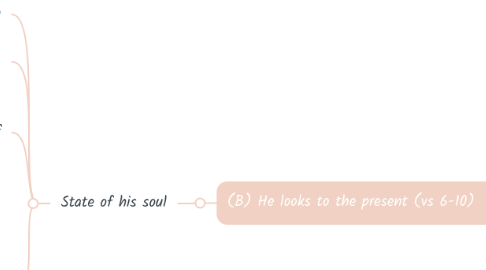
5. (B) He looks to the present (vs 6-10)
5.1. State of his soul
5.1.1. His soul is cast down
5.1.2. Nostalgia Helps his Soul (compare to verse 4)
5.1.3. He feels squashed by God himself
5.1.3.1. Crushing waterfalls- He’s stuck under a massive waterfall
5.1.3.2. Crushing waves
5.1.4. Yet he KNOWS things in spite of his circumstances
5.1.4.1. By day: God commands his steadfast love
5.1.4.2. By night: he still has within him a song of God and access to God through prayer
5.1.4.2.1. He calls God his rock
5.1.4.2.2. He questions God
6. (C) He looks to the future (vs 11)
6.1. He speaks to himself
6.1.1. Interrogation: oh soul, why?
6.1.2. Speaks truth: Hope in God
6.1.3. Assures himself: i will again praise him
6.1.4. Confesses his faith: my salvation and my God
6.1.4.1. Lingering Question: How is this supposed to be helpful? At the end of the day I’m still left in my predicament? So what actually changes?
6.1.4.1.1. First, It’s helpful in several ways
6.1.4.1.2. Second, we need to realize how we experience God best
7. (A) He looks to the past (vs 1-5)
7.1. The state of his soul
7.1.1. His tears have been the only thing his soul has feasted on
7.1.1.1. Depression: when the only thing you’re able to think about is your depression [verse 8 is a direct response to verse 3]
7.1.2. Nostalgia hurts his soul (compare to verse 6) He questions whether or not he will ever get back into the good presence of GOD
7.1.3. He’s tormented by the taunts of the enemy—their question seems to reinforce his depression: where is your God?
7.2. He speaks to himself
7.2.1. Interrogation: why are you cast down oh soul?
7.2.2. Speaks truth to himself: Hope in God
7.2.3. Assures himself: I will again praise him
7.2.4. Confesses his faith: my salvation and my God