


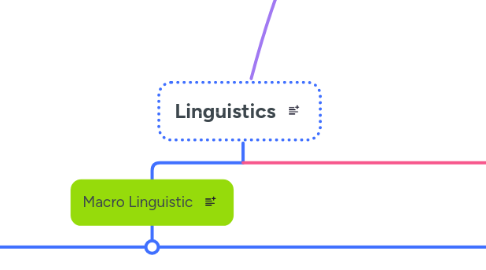
1. Macro Linguistic
1.1. Inter Disciplinary
1.1.1. Computational ling.
1.1.1.1. E.g, developing, improving, and maintaining machine translation systems. They apply their understanding of linguistic theory and translation to enhance the output quality of multilingual applications.
1.1.2. Cognitive Linguistics
1.1.3. Neurolinguistics
1.1.3.1. For example, when we understand or say a word like 'apple', we are likely to use information about what apples look, feel, smell, and taste like, even though we aren't aware of doing this. So listening, understanding, talking, and reading involve activities in many parts of the brain.
1.1.4. Psycholinguistics
1.1.4.1. Language acquisition
1.1.4.1.1. The study of language acquisition
1.1.4.1.2. Child language acquisition
1.1.4.1.3. Theories of language acquisition
1.1.5. Historical
1.1.5.1. Language families
1.1.5.1.1. Indo-European
1.1.5.1.2. Macro Altaic
1.1.5.2. Language isolate
1.1.6. Sociolinguistics
1.1.6.1. Examples of sociolinguistic study include gendered language differences, regional differences, and how social class impacts language use.
1.1.6.1.1. linguistic variations
1.2. Intra Disciplinary
1.2.1. Applied
1.2.2. Theoretical
1.2.2.1. Theoretical
1.2.2.1.1. Roman Jakobson
1.2.2.1.2. Saussure
1.2.2.1.3. A J Greimas
1.2.2.1.4. Signifier/Signified
1.2.3. Descriptive
1.2.3.1. Language classification
1.2.3.1.1. Genetic
1.2.3.1.2. Typological
1.2.3.2. Language characteristics
1.2.3.2.1. Definition
1.2.3.2.2. Language as a Subject
1.2.3.2.3. Language as a Means of Communication
1.2.3.2.4. Language is Arbitrary
1.2.3.2.5. Language is a System of Systems
1.2.3.2.6. Language is vocal
1.2.3.2.7. Language Vs Animal Communication
1.2.3.2.8. Language Is a Form of Social Behaviour
1.2.4. Comparative
2. Approaches
2.1. Synchronic Approach
2.1.1. is one of the two main temporal dimensions of language study introduced by Saussure in his "Course in General Linguistics" (1916).
2.1.1.1. For example, analyzing the word order in a sentence in Old English only would be a study in synchronistic linguistics.
2.2. Diachronic Approach
2.2.1. linguistics, which is the study of language through perios of time in history. The first looks at a snapshot of a language, and the other studies its evolution (like a frame of film vs. a movie).
3. Micro Linguistics
3.1. Phonetics
3.1.1. Types
3.1.1.1. Articulatory phonetics
3.1.1.2. Acoustic phonetics
3.1.1.2.1. Speech perception
3.1.1.3. Auditory phonetics
3.2. Phonology
3.2.1. Sounds and their variants
3.2.1.1. Phonemes
3.2.1.2. Allophones
3.2.2. Shapes of vowel systems
3.3. Morphology
3.3.1. Inflextional&Derivational
3.3.1.1. Inflectional morphemes
3.3.1.2. Derivational morphemes
3.3.2. Morpheme
3.3.2.1. Words are potentially complex units, composed of even more basic units, called morphemes.A morpheme is the smallest part of a word that has grammatical function or meaning.
3.3.2.1.1. free morphemes
3.3.2.1.2. bound morphemes
3.3.2.1.3. allomorphs
3.3.3. Word formation
3.3.3.1. Compounding
3.3.3.1.1. Examples: mailman (composed of free root mail and free root man) mail carrier dog house fireplace fireplug (a regional word for 'fire hydrant') fire hydrant dry run cupcake cup holder email e-ticket
3.3.3.2. • Affixation
3.3.3.2.1. Affixation (Subtype of Derivation) The most common type of derivation is the addition of one or more affixes to a root, as in the word derivation itself. This process is called affixation
3.3.3.3. • Blending
3.3.3.3.1. Examples : mocktail (mock and cocktail) 'cocktail with no alcohol' splog (spam and blog) 'fake blog designed to attract hits and raise Google-ranking' Britpoperati (Britpop and literati) 'those knowledgable about current British pop music'
3.3.3.4. • Clipping
3.3.3.4.1. For example, the word rifle is a fairly modern clipping of an earlier compound rifle gun, meaning a gun with a rifled barrel. (Rifled means having a spiral groove causing the bullet to spin, and thus making it more accurate.) Another clipping is burger, formed by clipping off the beginning of the word hamburger. (This clipping could only come about once hamburg+er was reanalyzed as ham+burger.)
3.3.3.5. • Acronyms
3.3.3.5.1. Examples: NOW (National Organization of Women) US or U.S., USA or U.S.A. (United States) UN or U.N. (United Nations) IMF (International Monetary Fund) , LOL - laughing out loud ROFL - rolling on the floor laughing
3.3.3.6. • Reanalysis
3.3.3.6.1. The example of the reanalysis is hamburger, which was originally Hamburger steak 'chopped and formed steak in the Hamburg style, then hamburger (hamburg + er), then ham + burger
3.3.3.7. • Folk etymology
3.3.3.7.1. Cheeseburger was formed on the analogy of hamburger, replacing a perceived morpheme ham with cheese. carjack and skyjack were also formed by analogy.
3.3.3.8. • Novel creation
3.3.3.8.1. Some examples of now-conventionalized words that were novel creations include blimp, googol (the mathematical term), bling, and possibly slang, which emerged in the last 200 years with no obvious etymology. Some novel creations seem to display 'sound symbolism', in which a word's phonological form suggests its meaning in some way. For example, the sound of the word bling seems to evoke heavy jewelry making noise.
3.3.3.9. • Creative respelling
3.3.3.9.1. Change of spelling is often used in commercials and slogans. For example Kleenex tissues, Mortal Kombat (game), Qwikster (movie-by-mail service). Misspelling quite often gives rise to brand names. Sometimes words are formed by simply changing the spelling of a word that the speaker wants to relate to the new word. Brand or Product names often involve creative respelling, such as Mr. Kleen or Krunch.
3.3.3.10. • segmentation
3.3.3.11. Coinage
3.3.3.11.1. Example : The expression "boy band" is a 1990s coinage. Examples of coined words: aspirin, kleenex, nylon, teflon, vaseline, zipper.
3.3.3.12. Backformation
3.3.3.12.1. the verb burgle from the older English noun burglar the verb diagnose from the older English noun diagnosis
3.3.3.13. onomatopoeia
3.3.3.13.1. The dog barked all night. The mouse went squeak as it ran across the room. The corn went pop in the microwave
3.3.3.14. Derivation
3.3.3.14.1. For example, "unhappy|adj" and "happiness|noun" are derived from "happy|adj" by prefix and suffix, respectively.
3.4. Semantics
3.4.1. • Examples of Semantic
3.4.1.1. *
3.4.1.1.1. • Slang
3.4.1.1.2. • Idioms
3.4.1.1.3. • Metaphors
3.4.1.1.4. • Irony
3.4.1.1.5. • Jargon
3.4.1.1.6. • Everyday expressions
3.4.1.1.7. • Hyperbole
3.4.1.1.8. • Emojis
3.4.1.1.9. • Sarcasm
3.4.1.1.10. • Colloquialisms
3.4.1.1.11. • Synonyms
3.4.1.1.12. • Antonyms
3.4.1.1.13. • Homonyms
3.4.1.1.14. • Homophones
3.4.1.1.15. • Polysemy
3.4.1.1.16. • Analogy
3.4.1.1.17. • Puns
3.4.1.1.18. • Taboo Language
3.4.1.1.19. • Connotation
3.4.1.1.20. • Euphemisms
3.4.2. Linguistic meaning
3.4.2.1. Denitation
3.4.2.1.1. Connatation
3.4.3. Philosophy and study of meaning in linguistics
3.4.3.1. Analyticity
3.4.3.1.1. Syntheticity
3.4.4. Linguistic ambiguity
3.4.4.1. Lexical ambiguity
3.4.4.2. Syntactic ambiguity
3.5. Pragmatics
3.6. Syntax
3.6.1. Sentence patterns
3.6.1.1. sentence patterns
3.6.1.1.1. subject
3.6.1.1.2. verb
3.6.1.1.3. objects
3.6.1.1.4. predicate
3.6.1.1.5. complements
3.6.2. rules for using commas
3.6.2.1. Never insert a lone comma between a subject and predicate or between the main verb and its complement(s).
3.6.2.2. Use two commas to separate off anything that interrupts the subject and predicate or the verb and its complement(s)
3.6.3. Structuralists view of Grammar
3.6.3.1. Leonard Bloomfield, the American linguist.
3.6.3.1.1. The essential structural approach to language is supposed to be composed of morphemes in sequence, i.e, strings of morphemes, and at a different level, of strings of phonemes. It was recognized that there were other units larger than morphemes, like tagmeme, taxeme, sememe and episememe.
3.6.3.2. Basic assumptions of structuralists
3.6.3.2.1. The structuralist grammar may describe two different states of the language
3.6.3.3. 'Poor John ran away'
3.6.3.3.1. sentences are made up of layers of immediate constituents, each lower level constituent being part of a higher level constituent.
3.6.3.4. Immediate constituent analysis
3.6.3.4.1. The aim of the immediate constituent analysis is to find out the parts of an utterance and how they are put together. It is assumed that an utterance is decomposable into small units. Moreover, the analysis should reveal the structure of the utterance - that -3, the arrangement of the units.
3.6.3.5. Transformational generative grammar
3.6.3.5.1. For example, transformational grammar relates the active sentence “John read the book” with its corresponding passive, “The book was read by John.” The statement “George saw Mary” is related to the corresponding questions, “Whom [or who] did George see?” and “Who saw Mary?” Although sets such as these active and passive sentences appear to be very different on the surface (i.e., in such things as word order), a transformational grammar tries to show that in the “underlying structure” (i.e., in their deeper relations to one another), the sentences are very similar.
3.6.3.6. Supra- Sentential Grammar
3.6.3.6.1. segmental units
3.6.3.6.2. supra-segmental units