


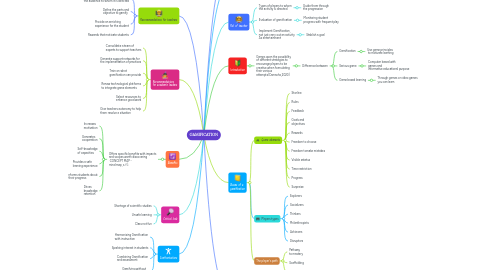
1. Cooperation and competition
2. At the teaching level, it is based on games to motivate students to get involved in the action of learning and problem solving (GAMIFICATION CONCEPT MAP - mind map, s. f.).
2.1. Traditionally, games have been used as an activity to spark students' interest in learning a topic; they can be used as a powerful tool to shape behavior (Camacho,2020)
3. Recommendations for teachers
3.1. Understand the characteristics of the audience to whom it is directed
3.2. Define the parts and objective to gamify
3.3. Provide an enriching experience for the student
3.4. Rewards that motivate students
4. Recommendations for academic leaders
4.1. Consolidate a team of experts to support teachers
4.2. Generate support networks for the implementation of practices
4.3. Train on what gamification can provide
4.4. Renew technological platforms to integrate game elements
4.5. Select resources to enhance good work
4.6. Give teachers autonomy to help them resolve a situation
5. Benefits
5.1. Offers specific benefits with impacts and scopes worth discovering CONCEPT MAP - mind map, s. f.).
5.1.1. Increases motivation
5.1.2. Generates cooperation
5.1.3. Self-knowledge of capacities
5.1.4. Provides a safe learning experience
5.1.5. nforms students about their progress
5.1.6. Drives knowledge retention
6. Critical look
6.1. Shortage of scientific studies
6.2. Unsafe learning
6.3. Class not fun
7. Rol of teacher
7.1. Types of players to whom the activity is directed
7.1.1. Guide them through the progression
7.2. Evaluation of gamification
7.2.1. Monitoring student progress with frequent play
7.3. Implement Gamification, not just carry out an activity As entertainment
7.3.1. Stablish a goal
8. Confrontations
8.1. Harmonizing Gamification with instruction
8.2. Sparking interest in students
8.3. Combining Gamification and assessment
8.4. Gamifying without dying in the attempt
9. Introduction
9.1. Games open the possibility of different strategies to encourage players to be creative when formulating their various attempts(Camacho,2020)
9.1.1. Difference between
9.1.1.1. Gamification
9.1.1.1.1. Use game principles to motivate learning
9.1.1.2. Serious game
9.1.1.2.1. Computer based with games and informative educational purpose
9.1.1.3. Game based learning
9.1.1.3.1. Through games or video games you can learn
10. Bases of a gamification
10.1. Game elements
10.1.1. Storline
10.1.2. Rules
10.1.3. Feedback
10.1.4. Goals and objectives
10.1.5. Rewards
10.1.6. Freedom to choose
10.1.7. Freedom tomake mistakes
10.1.8. Visible satatus
10.1.9. Time restriction
10.1.10. Progress
10.1.11. Surpraise
10.2. Players types
10.2.1. Explorers
10.2.2. Socializers
10.2.3. Thinkers
10.2.4. Philanthropists
10.2.5. Achievers
10.2.6. Disruptors
10.3. The player's path
10.3.1. Pathway to mastery
10.3.2. Scaffolding
10.3.3. Discovery