


Psychology- The scientific study of the mind and body
por Kay McCoy
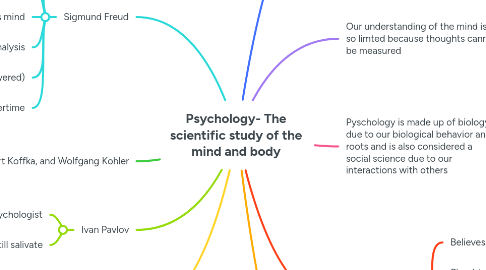
1. Sigmund Freud
1.1. Neurologist
1.2. Hysteria-exaggerated or inappropriate emotional behavior
1.3. Neurosis- Negative or obsessive thoughts that take over your life
1.4. Problems arise from the unconscious mind
1.5. Unconscious mind is responsible for urges and feelings which can be revealed by dream analysis
1.6. Psychoanalytic theory- unconscious mind + early childhood experiences (uncovered)
1.7. Development’s because of Freud…. Early childhood experiences that lead to adult motivations, the role in unconscious and conscious motivations driving our behavior, development of personality overtime
2. 3 physiologist who fled Nazi Germany and came to America Max Wertheimer, Kurt Koffka, and Wolfgang Kohler
2.1. Introduced the Gestalt principles to the United States- Focuses on the self as a whole , lead to the Humanistic Theory (accepting a person as a whole),
2.2. Gestalt principles now influence research in sensations and perceptions
3. Ivan Pavlov
3.1. Russian psychologist
3.2. Conditional reflex can go into the unconscious based on Salvia, Sound, and food., Take away the food, the person or dog will still salivate
4. John Watson
4.1. Observable behavior
4.2. Shifting psychology from mind to behavior
4.3. Observing and controlling behavior (Behavioralism)
5. Scientific method
5.1. 1. Researcher with a question as to why or how something happens
5.2. 2. Come up with a possible explination based on scientific findings and evidence (proven to be true overtime to increase reliability)
5.2.1. .
5.3. 3. Researcher than makes observations and carries out experiments to test their hypothesis
5.3.1. based on what is perceivable and measurable
5.4. 4. Researcher publishes and/or presents findings in order to advance science
6. Our understanding of the mind is so limted because thoughts cannot be measured
6.1. Empirical Method is based on observations and experimentation
7. Pyschology is made up of biology due to our biological behavior and roots and is also considered a social science due to our interactions with others
7.1. Soft skills developed include critical thinking and communication skills
7.2. Factors that shape oneself
7.2.1. Our biology
7.2.2. Environment
7.2.3. Experiences
8. Wilhelm Wundt
8.1. Believes goal of psychology was to understand oneself through introspection
8.1.1. Wundts ideas were highly subjective so people were speculative
8.2. Should study cultures and people
8.3. Believed that Voluntarism is important, people have free will and should get to know if they are being placed in a scientific experiment
8.4. Edward Titchener
8.4.1. Student of Wundt who developed structuralism
8.4.1.1. Structuralism is how are minds make meaning through a step-by-step process
8.5. In 1879 Wundt created the first laboratory for physiological research
8.5.1. Where he would light, pictures, or sounds and other stimulation to get a reaction time from the subject, the subject would press a button and the reaction time would be recorded