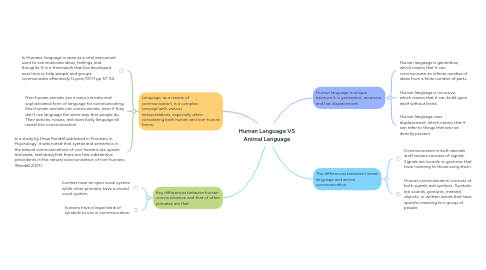
1. Language, as a means of communication, is a complex concept with various interpretations, especially when considering both human and non-human forms.
1.1. In Humans, language is seen as a vital instrument used to communicate ideas, feelings, and thoughts. It is a framework that has developed over time to help people and groups communicate effectively (Lyons,1977) pp 57-94. .
1.2. Non-human animals use a more intricate and sophisticated form of language for communicating. Non-human animals can communicate, even if they don't use language the same way that people do. Their actions, noises, and even body language all reveal this communication.
1.3. In a study by Drew Rendall published in Frontiers in Psychology, it was noted that syntax and semantics in the natural communications of non-humans are sparse and weak, indicating that there are few substantive precedents in the natural communication of non-humans (Rendall 2021).
2. Key differences between human communication and that of other primates are that
2.1. humans have an open vocal system while other primates have a closed vocal system.
2.2. humans have a larger bank of symbols to use in communication.
3. Human language is unique because it is generative, recursive, and has displacement.
3.1. Human language is generative, which means that it can communicate an infinite number of ideas from a finite number of parts.
3.2. Human language is recursive, which means that it can build upon itself without limits.
3.3. Human language uses displacement, which means that it can refer to things that are not directly present.
4. The differences between human language and animal communication.
4.1. Communication in both animals and humans consists of signals. Signals are sounds or gestures that have meaning to those using them.
4.2. Human communication consists of both signals and symbols. Symbols are sounds, gestures, material objects, or written words that have specific meaning to a group of people.